Quick Definition: Self employment vs employment comes down to one core trade-off: control versus security. Self-employed workers run their own business, set their own hours, and are personally responsible for their income, taxes, and benefits. Employees work for an organization that provides a regular paycheque, withholds taxes on their behalf, and typically offers benefits like health coverage, paid vacation, and employment insurance.
Most people who search “self employment vs employment” are not doing academic research. They are sitting at a desk job they tolerate, or they just got laid off, or they are freelancing on evenings and weekends and trying to figure out if the math ever makes sense to go full-time. The question is personal. And it deserves a real answer, not a generic pros-and-cons list that treats both options as equally appealing regardless of who you are.
Self employment vs employment is genuinely one of the more consequential decisions a working person can make. The gap between these two paths is not just about income or flexibility. It touches how you pay taxes, whether you qualify for employment insurance, how you save for retirement, and what happens if you get sick and cannot work for three months. Those things matter.
Canada has roughly 2.7 million self-employed workers, making up about 13.2% of the employed population according to Statistics Canada. More than 71% of them run solo operations with no employees. That tells you something: most self-employed people are not running startups or building empires. They are running a skill-based operation, often alone, trying to earn a living on their own terms.
This guide covers both sides honestly. The goal here is to help you figure out which one fits your actual situation.
What Is the Difference Between Self Employment and Employment?
Employment means you have entered a contract of service with an organization. You work under their direction, usually on their premises or their systems, using their equipment. They pay you a regular salary or hourly wage, deduct income tax and CPP contributions at source, and contribute the employer share of those deductions. You are covered by the Employment Standards Act, eligible for Employment Insurance, and protected by workplace safety legislation.
Self employment means you have entered a contract for services, usually with multiple clients. You work independently, use your own tools, set your own schedule, and bear the financial risk of the work. No one deducts tax from your income. No one pays the employer share of your CPP. You are responsible for all of that yourself.
The Canada Revenue Agency (CRA) uses a specific test to determine which classification applies. Key factors include who controls how the work gets done, who supplies the equipment, whether the worker can subcontract the tasks, and whether the worker faces financial risk. The last one is important: an employee cannot lose money on a job. A self-employed person can.
Working for Yourself vs Working for Someone Else: The Real Trade-Offs
Working for yourself vs working for someone else is not purely about money or hours. It involves your relationship with risk, your personal financial situation, and honestly, your personality.
Income: Ceiling vs Floor
Employment gives you a floor. You know what your paycheque will be on Friday. You budget around it. If business slows down, that is the employer’s problem, not yours.
Self employment gives you a ceiling. There is no cap on what you can earn. Some self-employed Canadians out-earn their salaried counterparts by a wide margin, especially in consulting, trades, creative services, and digital businesses. But there is no floor. A slow month is your problem. A client who does not pay is your problem. An industry downturn that cuts your contract work in half is very much your problem.
The honest answer is that most people who go self-employed do not immediately earn more than they did as employees. The first year or two tend to be the hardest. Income usually builds over time as you develop a client base, refine your pricing, and get better at finding work. It is not a quick win. It is a long game.
Self Employed vs Employee Tax Differences in Canada
This section alone is worth reading carefully, because the tax picture for self-employed Canadians surprises almost everyone who makes the switch.
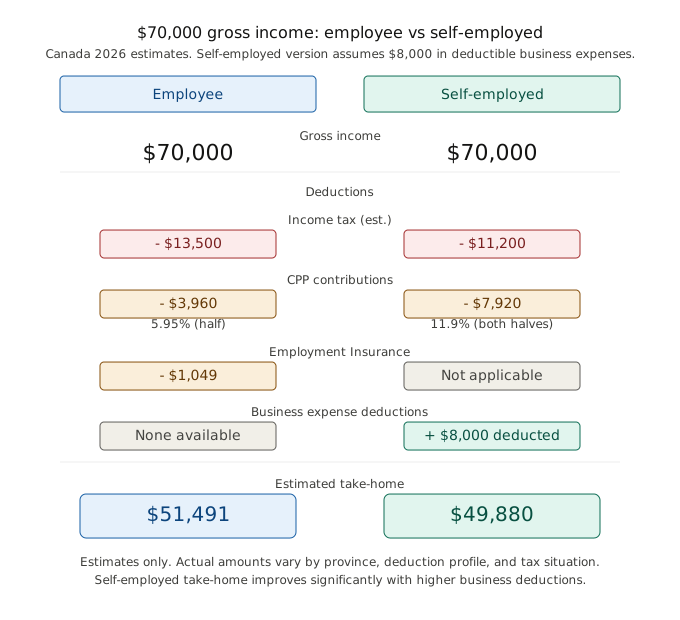
As an employee, your employer withholds income tax, deducts your share of CPP (5.95%), and contributes a matching employer share. You do not have to think about any of that. At tax time you file a T4 slip. Simple.
As a self-employed person, nobody withholds anything. You receive your gross income and you are responsible for setting aside money to cover:
- Federal and provincial income tax on your net business income
- Both the employee and employer shares of CPP, totalling 11.9% on net earnings between $3,500 and $71,300 for 2026
- CPP2 enhanced contributions at 8% on earnings between $71,300 and $81,200
- GST/HST if your revenue exceeds $30,000 in four consecutive quarters
The self-employed filing deadline is June 15, 2026 for the 2025 tax year, but any balance owing is due April 30. Missing that April 30 payment deadline triggers daily compound interest on what you owe, regardless of the June 15 filing extension.
The upside is that self-employed Canadians can deduct legitimate business expenses from their income before tax: home office costs, equipment, software, professional development, vehicle use for business, and more. A well-managed set of deductions can meaningfully reduce your taxable income. An employee gets none of that.
The self employed vs employee tax differences in Canada are significant enough that many people consult an accountant before making the switch. That is probably a good idea.
Employment Insurance and Benefits
Employees contribute to EI through payroll deductions. If they lose their job, they can apply for regular EI benefits. They also access special benefits for parental leave, illness, and caregiving.
Self-employed Canadians do not automatically qualify for EI. They can opt into the EI program voluntarily, but only the special benefits apply. Regular benefits for job loss are not available. And the opt-in is not free: you pay premiums and must wait 12 months before you can make a claim.
Paid vacation, sick days, and employer-sponsored health and dental benefits are also employee perks that disappear the moment you go self-employed. You either replace them out of pocket or go without. Many new self-employed workers underestimate how much these benefits were actually worth.
Job Security vs Independence
Job security is real, but it is not guaranteed. Layoffs happen. Contracts end. Companies restructure. The difference is that an employee rarely has to think about it day to day, while a self-employed person thinks about client retention constantly.
What self-employment offers in return is something most employment situations do not: the ability to fire a bad client, raise your rates, choose who you work with, and structure your days around your own peak productivity. That has genuine value. For some people it is worth more than the security of a regular paycheque. For others it would be a source of constant anxiety.
Neither answer is wrong. It is a personality question as much as a financial one.
Self Employment vs Employment: Side-by-Side Comparison
| Factor | Self Employment | Employment |
|---|---|---|
| Income predictability | Variable | Fixed / predictable |
| Income ceiling | Unlimited | Capped by salary band |
| Tax withholding | Your responsibility | Employer handles it |
| CPP contributions | Both halves (11.9%) | Employee half only (5.95%) |
| Employment Insurance | Opt-in only (special benefits) | Automatic (regular + special) |
| Paid vacation | Not provided | Typically included |
| Health/dental benefits | Self-funded | Often employer-sponsored |
| Business expense deductions | Yes | No |
| Work schedule control | High | Varies by employer |
| Protection under Employment Standards Act | No | Yes |
| Retirement planning | Self-directed (RRSP, TFSA) | May include pension |
| Who bears financial risk | You | Employer |
Is Self Employment Better Than Being an Employee?
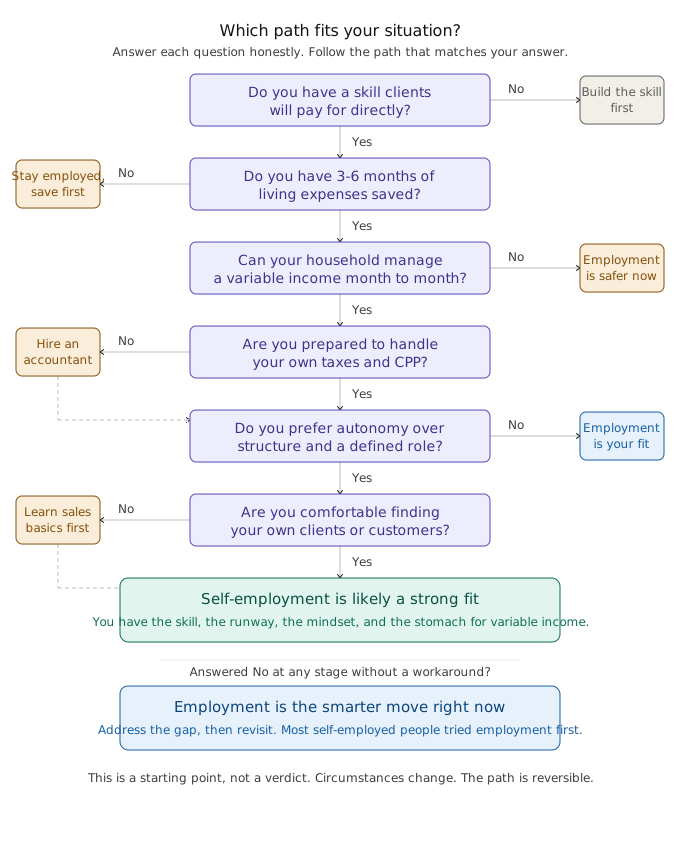
This depends entirely on where you are in life, what you want from work, and how you handle financial uncertainty.
Self employment tends to work better for people who:
- Have a marketable skill that clients will pay for directly (writing, design, bookkeeping, trades, coaching, development, photography, consulting)
- Have some savings to cover a slow first year
- Are comfortable managing their own taxes and finances, or willing to pay someone to help
- Find the structure of employment stifling
- Want to build something of their own, even if it is small
Employment tends to work better for people who:
- Need income predictability, especially with a mortgage or family to support
- Value the benefits package (health, dental, pension, parental leave)
- Prefer clear boundaries between work and personal time
- Are earlier in their career and still building skills
- Find the idea of finding their own clients stressful rather than energizing
There is no universal answer to whether self employment is better than being an employee. A freelance copywriter earning $120,000 a year with complete schedule control would tell you self-employment is obviously superior. A salaried nurse with a pension, full benefits, and job protection would likely disagree. Context is everything.
How Self Employment Works in Practice
A lot of people imagine self-employment as freedom. In some ways it is. In other ways it is more demanding than employment, just differently demanding.
When you work for yourself, you are not just doing the work. You are also finding the work, billing for the work, chasing late payments, managing your own schedule, handling your own taxes, and making every call about where the business goes. Some people find this energizing. Others find it exhausting. Both reactions are completely reasonable.
The administrative side is real. You need to track your income and expenses, keep receipts, understand which deductions apply to your situation, and either file your own taxes accurately or pay someone to do it. If your revenue exceeds $30,000 in four consecutive quarters, you need to register for GST/HST, charge it to clients, and remit it to the CRA.
You also need to replace things that employment provides automatically. That means building your own emergency fund, setting up your own RRSP or TFSA contributions for retirement, and either paying for private health and dental insurance or accepting that you will pay out of pocket.
None of this is impossible. Millions of Canadians do it successfully. But going in with a clear-eyed view of the full picture makes the transition far smoother than going in expecting it to feel like the same job but with more freedom.
The Grey Area: Misclassification
One issue that comes up often in the self employment vs employment conversation is misclassification. Some businesses prefer to classify workers as self-employed contractors even when the working relationship looks a lot like employment, largely because it offloads CPP matching and EI premiums to the worker.
The CRA has specific criteria for determining true employment status, and the classification is not something an employer gets to simply declare. If you are working under someone’s direct supervision, using their equipment, working exclusively for them, and the relationship looks like employment, the CRA may rule that it is employment, regardless of what your contract says. That creates liability for back taxes and missed deductions on both sides.
If you are in a situation where you are not sure how you are classified, or you suspect you may be misclassified, it is worth getting a clear answer. The CRA offers a process called a Ruling on Employment Status that can resolve the question formally.
Self-Employment Models: Which Type Makes Sense for You?
Self employment is not one thing. There are several distinct ways to structure it, and some work better than others depending on your goals.
Sole proprietorship is the simplest form. You operate as yourself under your own name or a registered business name. Income is reported on your T1 personal return using Form T2125. Low cost to set up, minimal paperwork, no legal separation between you and the business.
Incorporated business means you create a separate legal entity. The corporation files its own tax return and pays corporate tax rates, which are lower than personal income tax rates at higher income levels. It adds administrative complexity and cost but can offer significant tax advantages for higher earners who do not need to withdraw all their income immediately.
Partnership involves two or more self-employed people sharing a business. Each partner reports their share of income on their personal return.
Freelancing / contracting is essentially sole proprietorship under a different name. You sell a service directly to clients, usually on a project or retainer basis.
Understanding which model fits your situation is part of the decision. A side hustle testing the waters might start as a sole proprietor. A growing consulting practice might eventually incorporate for tax efficiency. For more on how these structures compare, take a look at the full breakdown of self-employment models on this site.
Quick Answers: Self Employment vs Employment
What is the main difference between self employment and employment?
The core difference is the employment relationship. Employees work under a contract of service and receive a regular paycheque with taxes deducted at source. Self-employed workers operate under a contract for services, bear the financial risk of the work, and are responsible for their own taxes, CPP contributions, and benefits.
Do self-employed people pay more tax in Canada?
Not necessarily more overall, but differently. Self-employed Canadians pay both halves of CPP (11.9% vs the employee half of 5.95%), which is a significant added cost. But they can also deduct business expenses that employees cannot. Whether the net tax burden is higher depends on income level and how well business expenses are tracked and claimed.
Can you be self-employed and still get Employment Insurance in Canada?
You can opt into the EI program voluntarily, but self-employed Canadians only qualify for special benefits (illness, parental, caregiving). Regular benefits for job loss are not available. You must register and pay premiums for 12 months before you can make a claim.
Frequently Asked Questions
Is self employment vs employment better for long-term earnings?
Self-employment has a higher ceiling but a lower floor, especially early on. Statistics Canada data shows that net self-employment income was reduced for most self-employed Canadians except the top 10% of earners. Over time, those who build strong client bases and manage their expenses well often out-earn comparable employees. It takes patience and discipline to get there.
How do I know if I am self-employed or employed in Canada?
The CRA uses a multi-factor test covering control over the work, ownership of tools, chance of profit, risk of loss, and integration into the business. If you work independently for multiple clients, use your own equipment, and bear financial risk, you are likely self-employed. If a single organization controls how and when you work and provides the tools, you are likely an employee. If the answer is not clear, you can request a formal Ruling on Employment Status from the CRA.
What happens to CPP if I become self-employed?
You become responsible for paying both the employee and employer contributions. For 2026, the self-employed CPP rate is 11.9% on net earnings between $3,500 and $71,300. There is also a CPP2 enhanced contribution at 8% on earnings between $71,300 and $81,200. This is one of the biggest financial adjustments people face when leaving employment.
What are the tax advantages of self employment over employment?
Self-employed Canadians can deduct business expenses from their income before calculating tax owed. This includes home office costs (if applicable), professional fees, equipment, software subscriptions, business-related travel, and more. Employees cannot deduct most work-related expenses. These deductions can meaningfully reduce taxable income, partially offsetting the higher CPP burden.
Can I switch back to employment after being self-employed?
Yes, and many people do. Some return to employment during slow economic periods, others after deciding self-employment is not the right long-term fit. Your self-employment experience is not a liability on a resume. Skills developed running your own operation, including client management, financial planning, and independent problem-solving, are valued by employers.
How much money should I save before going self-employed?
Most financial planners suggest having three to six months of living expenses saved before leaving employment. This gives you a runway to find clients, manage slow months in the early stages, and cover tax obligations without panic. If your industry has longer client acquisition cycles, err toward six months or more.
Is self-employment worth it in Canada?
For the right person in the right circumstances, yes. Canada has a supportive small business environment, and self-employment income qualifies for the same RRSP and TFSA contribution room as employment income. The administrative burden is real, but it is manageable with good habits and basic financial literacy. The question is not whether it is worth it in general. It is whether it is worth it for your situation, your skill set, and your risk tolerance.
Making the Choice That Fits Your Life
Self employment vs employment is ultimately a question about what kind of working life you want to build. Neither option is objectively superior. They involve different trade-offs, and those trade-offs land differently depending on where you are financially, what you do for work, and what you actually want from the hours you spend earning a living.
Employment offers stability, automatic benefits, and a defined role. If you are building a life that depends on predictable income, or you are in a profession where employer-sponsored benefits represent significant financial value, staying employed may be the smarter move for now.
Self-employment offers control, flexibility, and the possibility of building something that is entirely yours. It also demands that you carry financial responsibilities an employer used to handle. Going in with eyes open, a financial cushion, and a realistic view of what the first couple of years look like gives you the best possible chance of making it work.
If you are genuinely considering the switch, the next step is not just thinking about income. It is thinking about the full picture: taxes, CPP, EI, retirement savings, and what it will take to replace the benefits you currently receive without thinking about them.
For more on the practical side of getting started, see the guide to how to become self-employed in Canada and the breakdown of self-employment tax in Canada.