Starting an online coaching business has become one of the fastest-growing forms of digital self-employment. Coaches now use online platforms, video calls, digital courses, and membership communities to help clients achieve goals related to business, fitness, career development, personal growth, and professional skills.
Many entrepreneurs start an online coaching business because it combines low startup costs, scalable services, and flexible remote work opportunities. Unlike traditional consulting or local coaching businesses, online coaches can work with clients from anywhere in the world using digital tools and communication platforms.
Learning how to start an online coaching business involves defining a coaching niche, creating a structured coaching program, attracting clients, and building systems that allow the business to grow over time.
This guide explains the key steps required to start a successful online coaching business, including the core framework for launching your coaching services, choosing a niche, acquiring clients, and building scalable coaching systems.
Online Coaching by the Numbers
- The global coaching industry is valued at $20 billion and growing 6.7% annually (ICF, 2023)
- One-on-one coaching rates range from $100 to $1,000/hour depending on niche and experience level
- Coaches who offer group programs report 3x revenue compared to one-on-one only models
- 71% of coaches work fully online, eliminating location as a barrier to clients
- The average time from launch to $5,000/month in coaching revenue is 12 to 18 months
What Is an Online Coaching Business?
An online coaching business is a service-based business where a coach helps individuals or organizations achieve specific goals through digital communication platforms such as video calls, online courses, messaging apps, and membership communities.
Online coaches typically specialize in areas such as business coaching, fitness coaching, career coaching, life coaching, or skill development, delivering guidance and accountability through structured coaching programs.
Framework: How to Start an Online Coaching Business
Starting an online coaching business becomes much easier when entrepreneurs follow a structured framework. The process typically involves choosing a coaching niche, developing a coaching program, attracting clients, and building systems that allow the business to scale.
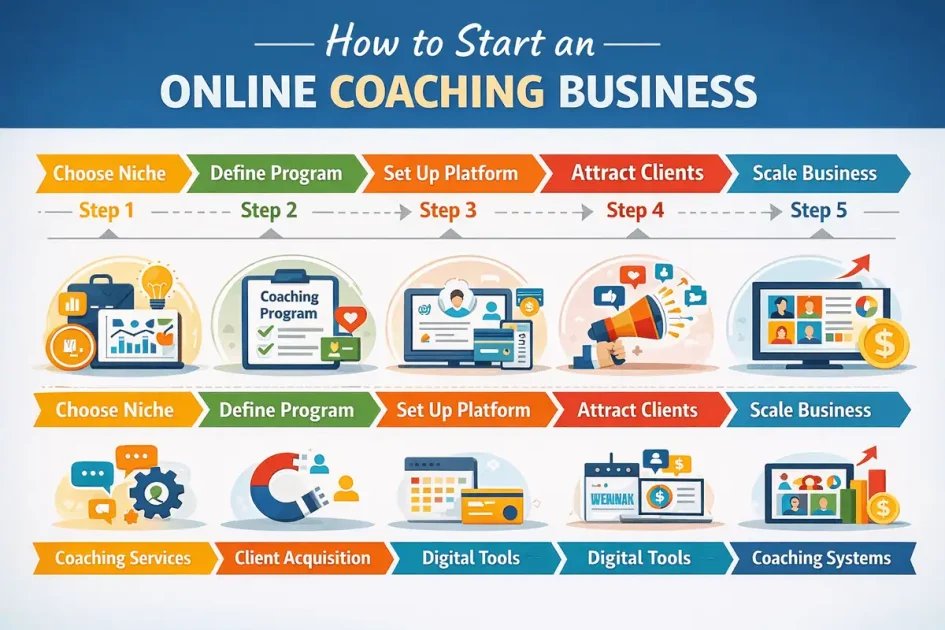
Step 1: Choose Your Coaching Niche
Successful online coaches specialize in a clear area of expertise.
Examples include:
• business coaching
• career coaching
• fitness coaching
• life coaching
• relationship coaching
• executive coaching
• marketing coaching
• productivity coaching
Choosing a niche helps coaches attract a specific audience and position themselves as experts.
Step 2: Define Your Coaching Program
Instead of selling one-off sessions, most coaches build structured coaching programs.
Examples:
One-on-One Coaching
• weekly video calls
• personalized strategy guidance
• accountability tracking
Group Coaching
• group sessions
• shared learning environment
• lower price point
Hybrid Programs
• coaching calls
• digital courses
• community support
Structured programs make it easier to deliver consistent results.
Coaches in this niche typically charge based on program type and experience. Industry data suggests that new coaches (under 1 year) typically earn $500 to $2,000/month while building a client base. One-on-one coaching rates range from $100 to $500/hour depending on niche and experience. Group coaching programs run $500 to $2,000 per participant per program, providing scalable income without a proportional increase in time. Business and executive coaches charge $300 to $1,000/hour at the senior level, while health and life coaches typically charge $75 to $200/hour.
Step 3: Set Up Your Online Coaching Platform
Online coaches rely on digital tools to deliver coaching services.
Common platforms include:
• Zoom or Google Meet
• Kajabi or Teachable
• Circle or Skool communities
• scheduling tools like Calendly
• payment platforms such as Stripe or PayPal
These tools allow coaches to manage sessions, payments, and client communication.
Step 4: Attract Your First Coaching Clients
Client acquisition is often the biggest challenge for new coaches.
Common strategies include:
• content marketing
• social media platforms
• webinars and workshops
• referrals and networking
• email marketing
Many coaches initially attract clients by sharing expertise through educational content.
Step 5: Build Systems and Scale the Coaching Business
As the business grows, systems allow the coach to serve more clients efficiently.
Examples include:
• automated onboarding
• structured coaching curriculum
• digital learning modules
• group coaching programs
• community memberships
These systems allow coaches to scale beyond one-on-one sessions.
Industry data suggests that established coaches with 1 to 3 years of experience and a defined niche commonly reach $3,000 to $10,000/month. Coaches who add group coaching programs or digital courses alongside one-on-one work report $10,000 to $50,000/month at scale. Online coaching revenue at scale reaches $10,000 to $50,000/month for coaches with an established audience and multiple program tiers.
Types of Online Coaching Businesses
Online coaching businesses can operate in many industries.
Business Coaching
Helping entrepreneurs grow businesses.
Fitness Coaching
Training clients through online fitness programs.
Career Coaching
Helping professionals advance in their careers.
Life Coaching
Supporting personal development and life goals.
Skill-Based Coaching
Teaching specific professional skills such as marketing or leadership.
Final
Learning how to start an online coaching business allows entrepreneurs to transform their expertise into a scalable digital service business. Because people increasingly seek guidance and mentorship online, coaching businesses continue to grow across many industries.
By choosing a niche, building structured coaching programs, attracting clients through content and marketing, and developing scalable systems, entrepreneurs can build a profitable online coaching business that serves clients worldwide.
For many professionals, launching an online coaching business becomes a powerful way to build digital self-employment and location-independent income.
FAQ: How to Start an Online Coaching Business
How do I start an online coaching business?
To start an online coaching business, choose a coaching niche, create a structured coaching program, set up digital platforms for communication and payments, and begin attracting clients through marketing and content.
Do you need certification to start an online coaching business?
Many coaching businesses do not require formal certification, although training programs can help build credibility and improve coaching skills.
How much does it cost to start an online coaching business?
Starting an online coaching business typically requires minimal startup costs, mainly covering website hosting, video communication tools, and marketing platforms.
Can online coaching be profitable?
Online coaching can be highly profitable because coaches sell expertise rather than physical products, allowing high margins and scalable programs.
How much can you earn from an online coaching business?
Online coaching income varies significantly by niche, audience size, and pricing model. New coaches typically earn $500 to $2,000/month in their first year while building a client base. Coaches with 1 to 3 years of experience and a defined niche commonly reach $3,000 to $10,000/month. Those who add group coaching programs or digital courses alongside one-on-one work report $10,000 to $50,000/month at scale. Business and executive coaches command the highest rates at $300 to $1,000/hour, while health and life coaches typically charge $75 to $200/hour.
see more related articles:


