Self employment in Canada continues to grow as individuals seek income independence, tax flexibility, and long-term wealth-building opportunities outside traditional employment structures.
However, becoming self employed in Canada is not simply about earning income independently. It requires navigating federal and provincial regulations, tax obligations, business registration requirements, and compliance structures specific to Canadian law.
This guide explains how self employment works in Canada, including legal setup, taxation, benefits implications, risk architecture, and long-term structural optimization — so you build a compliant and sustainable income system.
Self Employment in Canada: By the Numbers
- 2.9 million Canadians are self-employed, representing approximately 15% of the employed workforce (Statistics Canada, 2024)
- Median self-employment income in Canada: approximately $36,000 to $45,000 CAD per year (Statistics Canada)
- Self-employed Canadians pay CPP contributions on net self-employment income at both the employee and employer rates (approximately 11.9% combined in 2024)
- Freelance professionals in tech, consulting, and finance commonly earn $75,000 to $200,000+ CAD per year
- Sole proprietors must register for GST/HST once annual revenue exceeds $30,000 (Canada Revenue Agency threshold)
- Ontario has the highest concentration of self-employed Canadians; Alberta and BC follow (Statistics Canada)
What Is Self Employment in Canada?
Self employment in Canada refers to earning income independently by operating a business, providing services, or generating revenue from business activities rather than working as an employee under a contract of employment.
Self employed individuals are responsible for their own taxes, Canada Pension Plan contributions, and regulatory compliance.
Legal Structures for Self Employment in Canada
Choosing the correct legal structure determines liability exposure, tax treatment, and long-term flexibility.
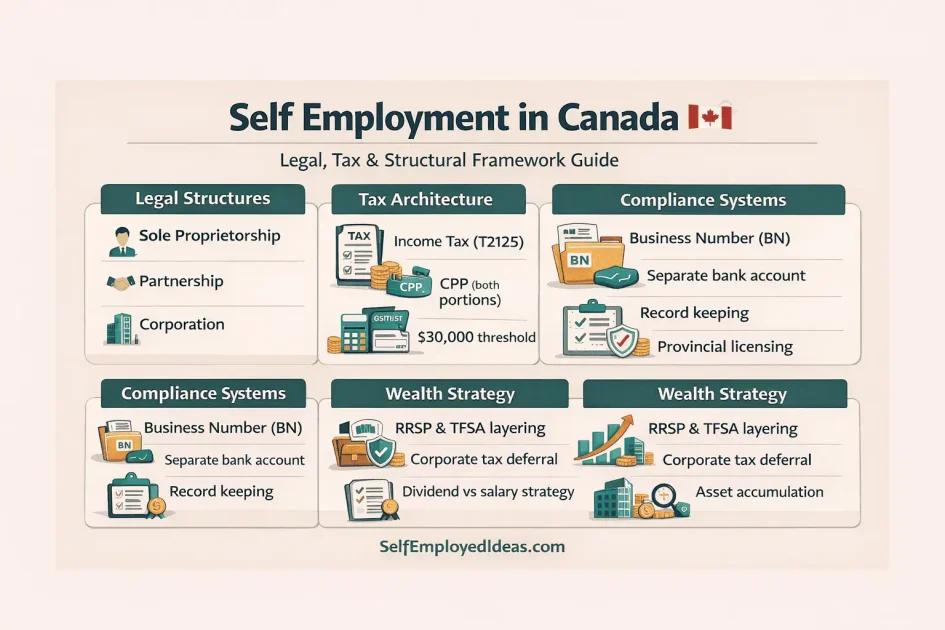
There are three primary structures.
1. Sole Proprietorship
The simplest and most common structure.
Characteristics:
- Business income reported on personal tax return (T1)
- No legal separation between owner and business
- Low startup cost
- Minimal administrative burden
Limitation:
Unlimited personal liability.
Best for:
Early-stage service providers or freelancers with low risk exposure.
2. Partnership
Two or more individuals operate together.
Characteristics:
- Income shared according to agreement
- Personal liability may apply
- Requires partnership agreement
Used when:
Skills or capital are combined.
3. Corporation
A separate legal entity.
Characteristics:
- Separate tax return (T2)
- Limited liability protection
- Potential tax deferral advantages
- Higher setup and compliance costs
Best for:
Higher income levels or scalable businesses.
Structural decision should align with income expectations and liability exposure.
Business Registration in Canada
Registration depends on structure and province.
You may need:
• Business name registration
• Business Number (BN) from CRA
• GST/HST registration (if threshold exceeded)
• Provincial licenses (depending on industry)
Failure to register when required can lead to penalties.
GST/HST Threshold Explained
One of the most misunderstood areas of Canadian self employment is sales tax.
You must register for GST/HST if:
Your total taxable revenues exceed $30,000 over four consecutive calendar quarters.
Below that threshold:
Registration is optional.
Above it:
Registration is mandatory.
Once registered, you must:
• Charge GST/HST
• File returns
• Remit collected tax
However, you may claim Input Tax Credits (ITCs) for eligible business expenses.
Understanding this threshold is critical for compliance.
Income Tax Obligations for Self Employed Canadians
Self employed income is reported on:
Form T2125 (Statement of Business or Professional Activities)
You pay:
• Federal income tax
• Provincial income tax
• Canada Pension Plan (CPP) contributions (both employer and employee portions)
Unlike employees, taxes are not automatically withheld.
You must set aside funds proactively.
CPP Contributions for Self Employed
Self employed individuals pay:
Both employee and employer portions of CPP.
This effectively doubles CPP contributions compared to employees.
However, contributions increase future retirement benefits.
Failing to budget for CPP creates cash flow strain.
Deductible Business Expenses in Canada
Self employed individuals can deduct reasonable business expenses including:
• Home office expenses
• Vehicle expenses (business portion)
• Professional services
• Marketing
• Equipment
• Software
• Internet and phone
Expenses must be:
Incurred to earn business income.
Improper deductions may trigger CRA review.
Cash Flow & Tax Planning Architecture
Canadian self employment requires tax discipline.
Recommended structure:
- Separate business bank account
- Allocate 25–35% of revenue for taxes
- Maintain quarterly installment awareness
CRA may require quarterly tax installments if tax payable exceeds threshold.
Financial structure must be proactive.
Provincial Considerations
Each province may require:
• Additional registration
• Specific licensing
• Workers’ compensation registration (if hiring)
Quebec operates separate provincial systems for:
• Sales tax (QST)
• Income tax administration
Provincial compliance must not be overlooked.
Self Employment Benefits & Limitations in Canada
Advantages:
• Expense deductions
• Flexible income structure
• Control over business growth
• Potential corporate tax planning
Limitations:
• No employer-provided benefits
• No automatic EI coverage (unless opted in)
• Income variability
Self employed Canadians must self-fund:
• Retirement
• Health insurance
• Disability coverage
Risk Architecture in Canadian Self Employment
Primary risks:
• CRA compliance risk
• Liability exposure
• Income fluctuation
• Regulatory oversight
Mitigation strategies:
• Maintain detailed records
• Use written contracts
• Carry liability insurance
• Separate business finances
Compliance reduces audit vulnerability.
Transitioning to Self Employment in Canada
Optimal path:
Phase 1 – Validate income part-time
Phase 2 – Register structure
Phase 3 – Open BN and accounts
Phase 4 – Secure tax buffer
Phase 5 – Transition full-time
Abrupt transition without compliance preparation increases risk.
Long-Term Wealth Strategy for Canadian Self Employed
Self employment allows integration of:
• Corporate tax deferral
• Dividend planning
• Income splitting (where legal)
• Asset layering (real estate, investments)
When structured correctly, Canadian self employment can become a tax-efficient wealth-building platform.
Sole Proprietorship vs Corporation – Tax Modeling Example
Understanding taxation is where most Canadian self employed individuals make structural mistakes.
Example Scenario:
Net Business Income: $120,000
Sole Proprietorship
Income taxed at personal marginal rates.
Assume combined federal + provincial rate ≈ 35–43% (varies by province).
Estimated tax payable:
$42,000–$50,000+
CPP contributions:
Both portions payable.
Total cash outflow can exceed $50,000.
Corporation (Small Business Deduction Eligible)
Corporate tax rate (small business rate):
~9–15% federal + provincial (varies by province).
Tax at corporate level:
≈ $12,000–$18,000
Funds can remain inside corporation and be reinvested.
Personal tax only triggered when income is withdrawn.
This creates tax deferral, not tax elimination.
Structural takeaway:
Incorporation benefits increase at higher income levels and when profits are retained for reinvestment.
CRA Installment Payment Architecture
Once your net tax owing exceeds $3,000 in a year (federal threshold outside Quebec), CRA may require quarterly installments.
Installment schedule:
• March
• June
• September
• December
Failure to pay installments may trigger interest charges.
New self employed individuals often underestimate installment impact.
Best practice:
• Allocate 30% of every payment received
• Hold in separate tax account
• Review annually with accountant
Cash flow discipline prevents tax shock.
These financial dynamics align closely with the principles outlined in the different ways income is generated, where income shifts from active to structured systems.
Applied Canadian Transition Scenario
Case Study: Ontario Graphic Designer
Year 1:
Side freelance income: $25,000
Below GST threshold.
Operates as sole proprietor.
Year 2:
Income grows to $65,000.
Must register for HST.
Begins charging 13% HST.
Files quarterly.
Year 3:
Income reaches $130,000.
Consults accountant.
Incorporates for liability protection and tax deferral.
Outcome:
Structured progression.
This progression mirrors how many individuals move through different ideas to start working for yourself before formalizing a long-term income structure.
No CRA penalties.
Improved cash management.
Contrast:
Impulsive transition without GST registration → CRA reassessment risk.
Compliance timing matters.
Compliance Failure Patterns in Canada
Common Canadian mistakes:
- Not registering for GST/HST on time
- Mixing personal and business finances
- Failing to track home office calculations correctly
- Underestimating CPP contributions
- Ignoring installment payment requirements
- Over-claiming vehicle expenses
CRA penalties often arise from record-keeping failure — not fraud.
Documentation protects you.
These risks are often the result of weak essential business systems, particularly in financial systems and compliance structure.
Retirement & Benefits Architecture
Employees receive:
• Employer CPP contributions
• Group health insurance
• Disability coverage
• Pension plans (sometimes)
Self employed Canadians must replace these manually.
Recommended structure:
• RRSP contributions
• TFSA layering
• Private health insurance
• Disability insurance
• Corporate investment accounts (if incorporated)
Without intentional retirement design, long-term wealth suffers.
Self employment increases freedom — but requires retirement discipline.
Many Canadians complement this with long-term leveraged income systems to build income beyond active work.
Provincial Nuances
Provincial tax rates vary significantly.
Example:
Ontario small business corporate rate ≈ 12.2% combined.
Alberta ≈ lower combined rates.
Quebec has separate QST registration and provincial tax filing.
Quebec also administers its own sales tax system (QST).
If operating across provinces:
Interprovincial sales tax rules may apply.
Provincial nuance increases complexity.
CRA Audit Risk & Record-Keeping System
Audit triggers may include:
• Large expense ratios
• Significant year-to-year income fluctuation
• Repeated losses
• Excessive home office claims
Best practices:
• Retain receipts digitally
• Track mileage logs
• Maintain bookkeeping software
• Separate accounts
Good record keeping reduces audit stress dramatically.
Business Structure Decision Framework (Canada-Specific)
Choosing between sole proprietorship and corporation in Canada should not be emotional — it should be threshold-based.
Use this structural decision model:
Stay Sole Proprietor When:
- Net income under ~$80,000
- Low liability exposure
- No major reinvestment strategy
- Administrative simplicity preferred
Consider Incorporation When:
- Net income consistently exceeds ~$100,000
- Profits will be retained for reinvestment
- Liability exposure increases
- Long-term asset accumulation planned
- Dividend planning becomes relevant
Incorporation is not always superior.
It becomes strategically beneficial at certain income and risk thresholds.
Structural timing matters more than structure itself.
Income Scaling & Incorporation Trigger Points
Canadian self employment often follows predictable income growth stages.
Stage 1 – Micro Self Employment ($0–$30,000)
Below GST/HST threshold.
Testing viability.
Stage 2 – Growing Sole Proprietor ($30,000–$100,000)
GST/HST registered.
Quarterly tax discipline required.
Cash flow discipline critical.
Stage 3 – Strategic Evaluation ($100,000–$150,000)
Incorporation evaluation stage.
Tax deferral begins to matter.
Liability exposure grows.
Stage 4 – Structured Corporate Growth ($150,000+)
Corporate income retention.
Dividend vs salary strategy.
Corporate investment layering.
Understanding these income phases prevents premature or delayed structural shifts.
At this stage, many individuals begin transitioning toward scalable long-term income streams to reduce reliance on personal effort.
Canadian Self Employment Income Forecast Model
Before transitioning full-time, forecast:
Projected Revenue
– Operating Expenses
– Sales Tax (collected vs remitted difference)
– Income Tax Allocation
– CPP Contributions
= Net Personal Take-Home
Example:
Revenue: $120,000
Expenses: $25,000
Net Income: $95,000
Tax allocation (~30%): $28,500
CPP approx: $7,000+
Estimated take-home ≈ $59,000
Many new self employed Canadians overestimate take-home income.
Forecasting protects lifestyle stability.
Long-Term Canadian Wealth Integration Strategy
Self employment in Canada is powerful when integrated with:
• RRSP contributions for tax deferral
• TFSA growth for tax-free accumulation
• Corporate retained earnings investment
• Real estate acquisition
• Dividend-producing portfolios
The structural advantage of Canadian self employment is flexibility.
You can:
• Decide salary vs dividends
• Optimize taxable income
• Layer corporate investments
• Time withdrawals strategically
However, optimization requires accounting guidance.
Without planning, tax efficiency is lost.
Structural Resilience in Canadian Markets
Canada has:
• Regulated tax systems
• Strong banking infrastructure
• Clear compliance standards
• Stable property markets
This creates a relatively predictable environment for structured self employment.
However:
• Regulatory non-compliance carries penalties
• Tax mismanagement compounds quickly
• Provincial differences create complexity
Resilience in Canada comes from structure and discipline.
Strengthened Institutional Close (Canada-Specific)
Self employment in Canada is not informal freelancing.
It is participation in a regulated economic system governed by federal and provincial tax law.
Success requires:
• Legal structure clarity
• GST/HST compliance
• CPP planning
• Installment awareness
• Expense documentation
• Long-term wealth layering
Canadian self employment becomes powerful when approached as a structured financial platform rather than a short-term income alternative.
When engineered properly, it allows:
Income autonomy
Tax flexibility
Asset accumulation
Corporate scaling
Intergenerational wealth planning
It rewards discipline.
It punishes improvisation.
Multi-Province Operating Example
Consider a consultant based in Ontario serving clients in Alberta and British Columbia.
Revenue: $140,000
Registered for HST (Ontario 13%).
When invoicing Alberta clients:
No provincial sales tax in Alberta — but HST still applies based on place-of-supply rules.
When serving BC clients:
GST may apply depending on service classification.
If operating nationally, you must understand:
• Place-of-supply rules
• Interprovincial tax application
• Digital service tax considerations
• Corporate residency rules
National service delivery increases compliance complexity.
Successfully scaling across markets often depends on strong scalable marketing systems to maintain consistent client acquisition.
As income grows, cross-province exposure requires professional tax guidance.
Advanced Canadian Tax Optimization Layer
Once incorporated, Canadian self employed individuals gain strategic flexibility.
Options include:
Salary Strategy
Pay yourself salary.
Creates RRSP room.
Reduces corporate retained earnings.
Dividend Strategy
Pay dividends.
Lower CPP burden.
No RRSP room generated.
Hybrid Compensation Strategy
Blend salary and dividends to balance:
• Tax efficiency
• CPP contribution
• RRSP eligibility
• Cash flow needs
Additionally, retained earnings inside a corporation can be:
• Invested in market portfolios
• Used for real estate acquisition
• Reinvested into business expansion
The advantage is tax deferral — not elimination.
Proper structuring transforms self employment from income replacement into long-term capital strategy.
Canadian self employment becomes significantly more powerful when integrated with scalable asset-based income ideas and structured business systems.
Final
Self employment in Canada operates within a stable but highly regulated economic system.
The opportunity is significant — but only for those who respect compliance architecture.
At its core, Canadian self employment requires:
• Structural registration
• Sales tax awareness
• CPP responsibility
• Installment discipline
• Accurate record keeping
• Strategic income planning
When approached casually, it produces tax stress and regulatory risk.
When engineered deliberately, it becomes:
A tax-flexible income platform
A corporate scaling mechanism
A wealth accumulation structure
A multi-province economic opportunity
Self employment in Canada is not just about working independently.
It is about participating intelligently in Canada’s fiscal framework while building independent income and asset ownership.
Conclusion
Self employment in Canada offers independence and long-term wealth potential — but it requires structural compliance with federal and provincial regulations.
Success depends on:
• Choosing the correct legal structure
• Registering appropriately
• Understanding GST/HST obligations
• Managing taxes proactively
• Protecting against liability
• Designing income stability
Canadian self employment is not informal freelancing.
It is a regulated income system that must be engineered carefully.
When structured properly, it becomes a durable and scalable financial foundation.
FAQ: Self Employment in Canada
Do I need to register to be self employed in Canada?
Not always. Sole proprietors operating under their legal name may not need name registration, but tax obligations still apply.
When do I need to charge GST/HST?
When taxable revenues exceed $30,000 over four consecutive calendar quarters.
Do self employed Canadians pay more tax?
They pay both portions of CPP and must manage their own tax remittance, but they can deduct eligible business expenses.
Do I qualify for EI if self employed?
Generally no, unless voluntarily registered for EI special benefits.
Should I incorporate in Canada?
Incorporation may provide liability protection and tax planning benefits, especially at higher income levels.
How much do self-employed Canadians earn?
Self-employment income in Canada spans a wide range. Statistics Canada data shows a median of approximately $36,000 to $45,000 CAD per year across all self-employed individuals, but this figure includes many part-time and entry-level operators. Established self-employed professionals earn significantly more: freelance developers and IT consultants in major Canadian cities commonly earn $80,000 to $150,000+ CAD per year; marketing consultants and financial advisors earn $75,000 to $200,000+ CAD per year; skilled tradespeople including electricians and plumbers in Ontario and Alberta typically earn $70,000 to $120,000+ CAD per year. For digital businesses like affiliate sites, courses, and e-commerce, income is not geographically bound and follows the same benchmarks as U.S. operators: $2,000 to $20,000+ CAD per month for established operators. The tax implication to note is that self-employed Canadians pay the full CPP contribution rate (employer + employee) on net income, which adds approximately 11.9% to the effective tax burden relative to employment, partially offset by the deductibility of legitimate business expenses.