The cashflow quadrant is a framework that explains how individuals earn income and how those income types influence financial independence. Popularized by Robert Kiyosaki in Rich Dad Poor Dad, the model divides income into four categories: employees, self-employed individuals, business owners, and investors. Understanding the differences between these quadrants helps individuals make better decisions about income, scalability, and long-term wealth building.
This framework applies to many self employment ideas, helping individuals choose the right path toward financial independence.
Cashflow Quadrant by the Numbers
- 93% of Americans operate in the E or S quadrant their entire working lives
- S quadrant earners (self-employed) trade time for money with no income while not working
- B and I quadrant income is not directly tied to hours worked
- Transitioning from E to S quadrant takes an average of 12 to 18 months to match prior salary
- Moving from S to B quadrant, building a business that runs without you, typically takes 3 to 7 years
What Is The Cash Flow Quadrant?
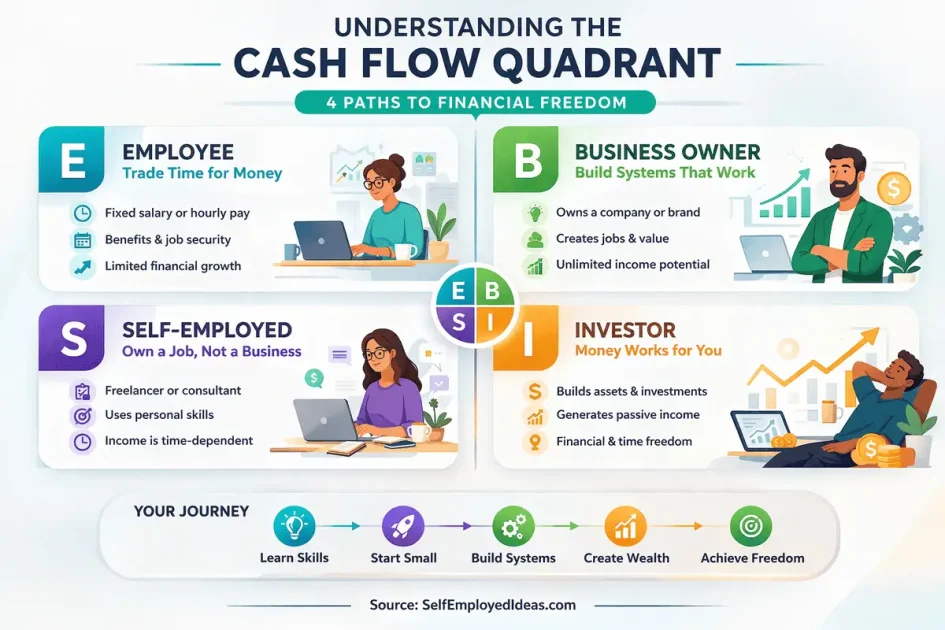
The cashflow quadrant is a framework that categorizes how people earn income into four types: employee (E), self-employed (S), business owner (B), and investor (I), each representing different levels of control, scalability, and financial independence.
How the Cashflow Quadrant Works
The cashflow quadrant organizes income into four distinct categories:
| Quadrant | Description |
| E (Employee) | Earns income through a job |
| S (Self-Employed) | Works for themselves |
| B (Business Owner) | Owns systems that generate income |
| I (Investor) | Earns income from assets |
Each quadrant represents a different way of generating income and building wealth.
The Four Cashflow Quadrants Explained
Employee (E): Earned Income Through Jobs
Employees trade time for money by working for an employer.
Characteristics:
• stable income
• limited control
• fixed working hours
• income tied directly to time
Example:
• office worker
• retail employee
• corporate professional
Limitation:
Income growth is often limited by salary and time availability.
Income data for this quadrant shows the median US salary is $59,384/year (BLS, 2024), with income ceiling limited by compensation structure and time available to work.
Self-Employed (S): Working for Yourself
Self-employed individuals own their job but still trade time for income.
Characteristics:
• greater control
• income depends on personal effort
• limited scalability
• high responsibility
Example:
• freelancers
• consultants
• small business owners
• tradespeople
Many self employment models fall into this category, especially in the early stages of building independent income.
Income data for this quadrant shows the median self-employed income is $34,751/year, with skilled S quadrant operators in consulting, freelancing, and professional services commonly earning $75,000 to $200,000/year. Kiyosaki’s framework suggests that S quadrant income is capped by available personal hours.
Business Owner (B): Systems Generate Income
Business owners create systems that generate income independently of their direct involvement.
Characteristics:
• scalable income
• systems and processes
• team-based operations
• less reliance on personal time
Example:
• agency owners
• SaaS founders
• e-commerce business owners
This quadrant represents a shift from working in the business to owning the business.
Building scalable systems in this quadrant requires strong business foundations, including operational structure, financial control, and leadership systems.
These systems rely heavily on effective marketing and growth systems to generate consistent demand and scale revenue.
Kiyosaki’s framework suggests that B quadrant businesses are scalable beyond personal time. Income data for this quadrant shows that established businesses commonly sell for 2 to 5x annual revenue, making business ownership one of the most effective wealth-building vehicles.
Investor (I): Income from Assets
Investors earn income through capital rather than labor.
Characteristics:
• passive or semi-passive income
• asset-based wealth
• compounding returns
• scalable income
Example:
• stock investors
• real estate investors
• dividend income earners
This quadrant is often associated with long-term financial independence.
If you are just starting, this guide on passive income for beginners explains how to enter the investor quadrant step by step.
This quadrant aligns closely with passive income strategies that focus on generating income through assets rather than active work.
Real estate investing is one of the most common ways individuals enter the investor quadrant through income-producing assets.
Income data for this quadrant shows rental property yields of 4 to 10% annually, dividend portfolios yielding 2 to 5%, and passive income potential that is uncapped as asset values and portfolio size increase over time.
Key Differences Between Quadrants
| Factor | E | S | B | I |
| Income Source | Job | Self-work | Systems | Assets |
| Scalability | Low | Limited | High | Very High |
| Time Dependency | High | High | Medium | Low |
| Control | Low | Medium | High | High |
Why the Cashflow Quadrant Matters for Self Employment
The cashflow quadrant provides a clear understanding of how income evolves.
Many individuals start in:
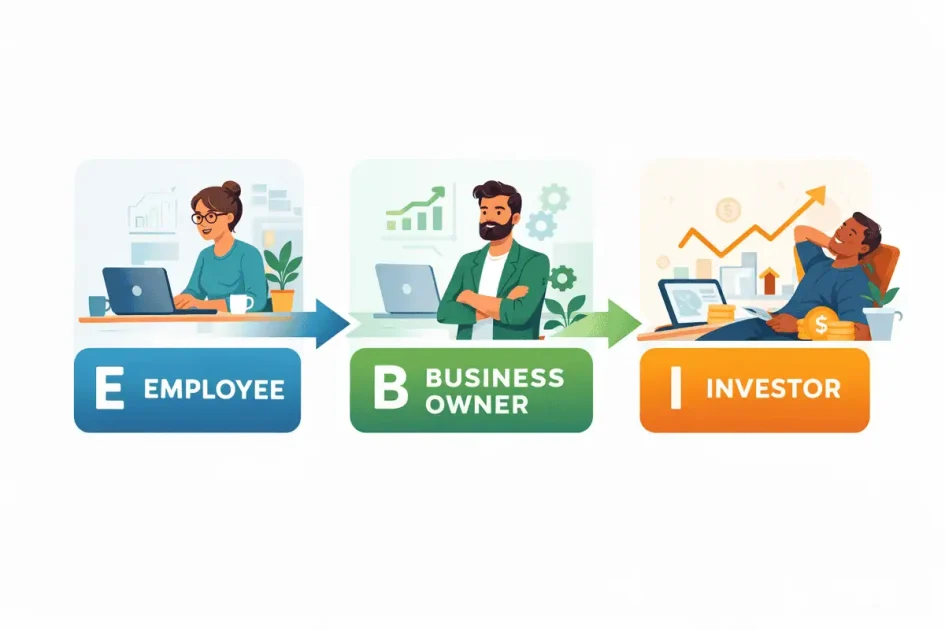
E → S → B → I
This progression shows how:
• employees transition into self employment
• self-employed individuals build businesses
• business owners invest to create passive income
Understanding this path helps individuals design long-term income strategies.
Transitioning Between Quadrants
Moving between quadrants requires different strategies.
From E to S:
• start a side hustle
• develop skills
• build independent income
From S to B:
• create systems
• hire or outsource
• reduce time dependency
From B to I:
• reinvest profits
• acquire assets
• diversify income streams
How the Cashflow Quadrant Connects to Financial Independence
Financial independence is typically achieved by moving toward:
👉 Business ownership (B)
👉 Investing (I)
Because these quadrants allow:
• scalable income
• reduced time dependency
• long-term wealth accumulation
Active vs Passive Income in the Cashflow Quadrant
The left side (E + S):
• active income
• time-based
• limited scalability
The right side (B + I):
• passive or leveraged income
• system-based
• scalable
The goal for many individuals is to transition from the left side to the right side.
Why the Cashflow Quadrant Matters
Understanding the cashflow quadrant changes how individuals think about income.
Instead of focusing only on:
• how much money you earn
It shifts focus to:
• how income is generated
This distinction is critical for:
• financial independence
• long-term wealth
• income diversification
Transitioning Between Quadrants
Most people follow a progression:
Stage 1: Employee to Self-Employed
• gaining skills
• starting side income
Common Misunderstandings
1. Self-employed ≠ business owner
Many people believe owning a job equals owning a business.
2. Passive income is not immediate
Building income in the B and I quadrants takes time.
3. All quadrants have value
Each quadrant serves a purpose depending on goals and risk tolerance.
Strategic Insights for Entrepreneurs
• self employment is often the first step toward independence
• building systems is the key to scalability
• investing is the key to long-term wealth
• authority and expertise accelerate transitions
Common Misunderstandings About the Cashflow Quadrant
“Self-Employed Means Financial Freedom”
Not necessarily — income is still tied to effort.
“Business Owners Don’t Work”
Most business owners still work, especially early on.
“Investing Requires Huge Capital”
Many investment strategies can start small and grow over time.
Strategic Use of the Cashflow Quadrant
To use this framework effectively:
• identify your current quadrant
• understand its limitations
• build a transition strategy
The goal is not to abandon one quadrant immediately but to gradually shift toward scalable income systems.
Cashflow Quadrant and Financial Independence
Financial independence is typically achieved when:
• income from B + I > living expenses
At that point:
• reliance on active work decreases
• income becomes system-driven
Final Thoughts
The cashflow quadrant explains how different income types impact financial independence by categorizing income into employee, self-employed, business owner, and investor roles. Understanding this framework helps individuals move from trading time for money toward building scalable income systems and asset-based wealth, making it a powerful tool for long-term financial planning.
Frequently Asked Questions About the Cashflow Quadrant
Which quadrant is best?
The business owner and investor quadrants are often considered the most effective for building long-term wealth because they allow scalable and asset-based income.
Can you be in more than one quadrant?
Yes. Many individuals earn income from multiple quadrants simultaneously, such as running a business while investing in assets.
Is self-employment better than employment?
Self-employment offers more control but may lack scalability unless systems are developed. It often serves as a transition toward business ownership.
How do you move from S to B?
To move from self-employed to business owner, individuals must build systems, delegate work, and reduce reliance on their own time.
How does the Cashflow Quadrant relate to self-employment income?
Robert Kiyosaki’s Cashflow Quadrant places self-employed individuals in the S quadrant, where income is directly tied to personal time and effort. The median self-employed income is $34,751/year, but skilled S quadrant operators in consulting, freelancing, and professional services commonly earn $75,000 to $200,000/year. The framework argues that true financial independence requires moving toward the B and I quadrants, where income continues without active work. For most self-employed people, the path is E to S first, then building systems that transition toward B.