Self employment can take many different forms depending on the type of work performed, the structure of the business, and how income is generated. Some self-employed individuals provide services directly to clients, while others build online businesses, sell products, or generate income through investments.
Understanding the different types of self employment helps individuals identify the business models that best match their skills, resources, and financial goals. Each category offers unique opportunities and challenges.
In this guide, we explore the major types of self employment and explain how each model works.
Types of Self-Employment by the Numbers
- Freelancing is the most common form, representing 38% of self-employed workers (Upwork, 2023)
- Consulting and professional services have the highest hourly rate ceiling at $75 to $300/hour
- Digital and online business models have grown 47% since 2020
- Service-based self-employment reaches profitability fastest, often within 90 days
- Product-based self-employment has the highest scaling potential but requires the most upfront capital
What Are the Types of Self Employment?
Types of self employment refer to the different ways individuals earn income independently without working as employees for an organization.
Self-employed individuals typically:
• operate their own businesses
• work as independent contractors
• sell products or services directly to customers
• generate income from owned assets
The most common types of self employment include service businesses, digital businesses, product businesses, local businesses, and asset-based income models.
Framework: Major Types of Self Employment
Most self employment models fall into several major categories.
Understanding these categories makes it easier to choose the right business structure.
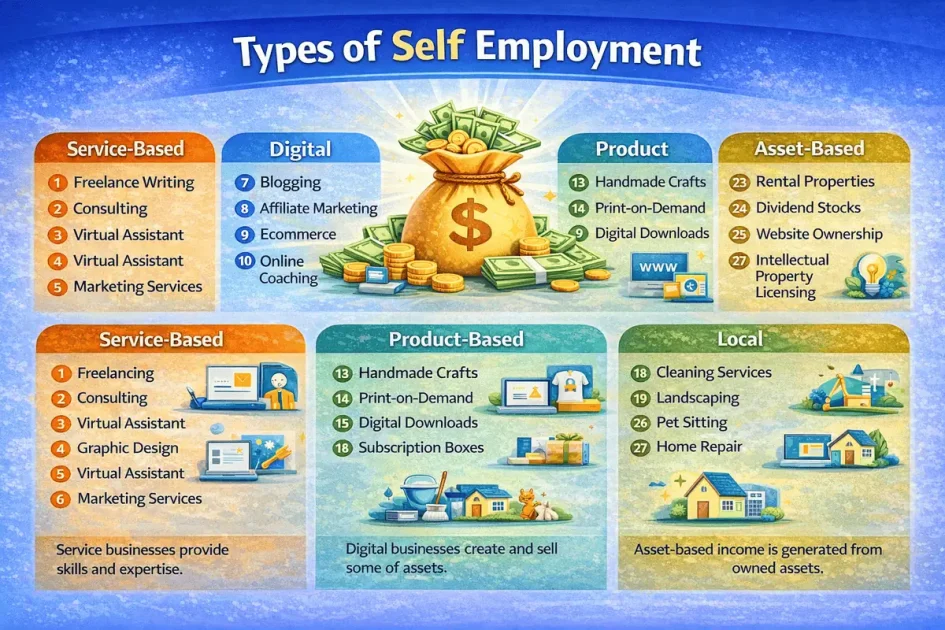
Service-Based Self Employment
Service businesses involve providing skills or expertise to clients.
Examples include:
• freelance writing
• consulting
• graphic design
• virtual assistant services
• marketing services
Service businesses are often the easiest type of self employment to start because they require minimal startup capital.
This type of self-employment typically generates $25 to $150/hour depending on skill level and niche, with established solo operators commonly earning $40,000 to $100,000/year.
Digital Self Employment
Digital businesses operate primarily online and can reach customers globally.
Examples include:
• blogging
• affiliate marketing
• ecommerce
• online coaching
• SaaS businesses
Digital self employment often provides opportunities for scalable income.
This type of self-employment typically generates $500 to $20,000/month depending on audience size, with digital products and online businesses representing one of the fastest-growing income categories.
Product-Based Self Employment
Product businesses involve creating or selling physical or digital goods.
Examples include:
• handmade crafts
• print-on-demand products
• digital downloads
• subscription boxes
Product-based businesses can generate recurring revenue through repeat customers.
This type of self-employment typically generates $1,000 to $15,000/month for focused niche stores, with physical product businesses scaling through inventory and distribution systems.
Local Self Employment
Local businesses provide services to customers within a geographic area.
Examples include:
• cleaning services
• landscaping
• pet sitting
• home repair services
These businesses often grow through referrals and local demand.
This type of self-employment typically generates $40,000 to $100,000/year for solo operators in skilled trades and local services.
Asset-Based Self Employment
Some individuals generate income from assets rather than active work.
Examples include:
• rental properties
• dividend stocks
• website ownership
• intellectual property licensing
Asset-based income models can produce long-term passive income.
This type of self-employment typically generates 4 to 10% annual ROI on rental properties and 2 to 5% on dividend portfolios, with income potential increasing as assets accumulate over time.
Comparison of Types of Self Employment
| Type of Self Employment | Startup Cost | Income Speed | Scalability |
| Service Businesses | Low | Fast | Medium |
| Digital Businesses | Low | Medium | High |
| Product Businesses | Medium | Medium | High |
| Local Businesses | Low | Fast | Medium |
| Asset-Based Income | Medium | Slow | High |
This comparison highlights how different types of self employment vary in terms of investment, growth potential, and time required to generate income.
How to Choose the Right Type of Self Employment
Choosing the right business model depends on several factors.
Skills and Experience
Some business types rely heavily on specialized skills or professional expertise.
Startup Capital
Certain businesses require little investment, while others require equipment, inventory, or property.
Income Goals
Some individuals seek flexible income, while others aim to build scalable businesses.
Long-Term Strategy
Many entrepreneurs start with service work and eventually transition into digital businesses or asset-based income.
Conclusion
Understanding the different types of self employment helps aspiring entrepreneurs explore the wide variety of opportunities available outside traditional employment. From service businesses and online companies to product ventures and investment income, self employment exists in many forms across industries.
Each of these types of self employment offers unique advantages depending on an individual’s skills, resources, and long-term goals. Some people begin with simple service businesses that generate immediate income, while others focus on building scalable digital companies or long-term asset-based income streams.
By learning about the major types of self employment, individuals can better identify the business models that align with their strengths and build sustainable independent income.
FAQ: Types of Self Employment
What are the main types of self employment?
The main types of self employment include service businesses, digital businesses, product-based businesses, local service businesses, and asset-based income models.
What is the most common type of self employment?
Service-based businesses such as freelancing, consulting, and local service companies are among the most common types of self employment.
Can digital businesses be considered self employment?
Yes. Online businesses such as blogging, affiliate marketing, ecommerce, and digital marketing agencies are common types of digital self employment.
Which type of self employment is easiest to start?
Service businesses are often the easiest to start because they require minimal startup capital and rely on existing skills.
Which type of self-employment is most profitable?
Profitability depends on skills, time horizon, and startup capital. Consulting and freelance services in high-demand niches are most profitable in the short term, with rates of $75 to $300/hour and low overhead. Digital business models including online courses, affiliate marketing, and SaaS products have the highest long-term ceiling but typically take 12 to 36 months to scale. Service-based businesses reach break-even fastest, often within 60 to 90 days of launching.