Self employment is a broad self employment ecosystem that includes business models, income systems, marketing strategies, and wealth-building frameworks that help individuals generate independent income outside traditional employment.
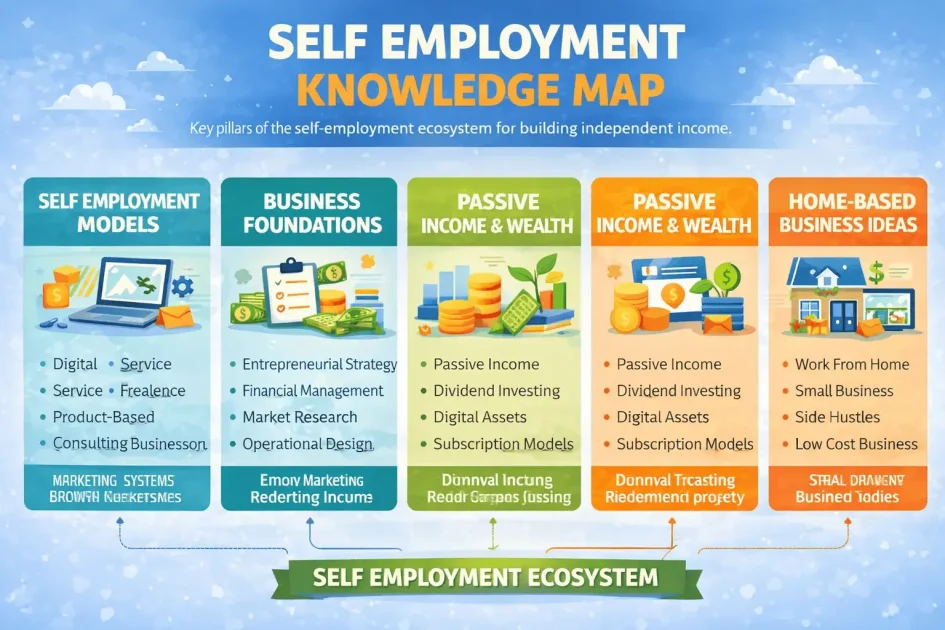
The Self Employment Knowledge Map organizes the core topics covered on SelfEmployedIdeas.com. Instead of viewing business ideas, passive income strategies, marketing systems, and real estate investing as separate topics, this map shows how they fit together to form a complete self employment framework.
By exploring each section below, readers can navigate the major knowledge pillars required to build, grow, and scale independent income.
The Self Employment Knowledge Map visually organizes how these topics connect, helping readers understand the complete structure of entrepreneurship and independent income.
What is the self employment ecosystem?
The self employment ecosystem includes business models, income systems, marketing strategies, and wealth-building frameworks that help individuals generate independent income outside traditional employment.
What Is the Self Employment Knowledge Map?
The Self Employment Knowledge Map is a structured overview of the main topics required to build independent income, including business models, entrepreneurial foundations, passive income systems, marketing strategies, real estate investing, and home-based businesses.
This framework organizes complex information into a clear hierarchy so readers can easily understand:
• how different types of self employment work
• what skills entrepreneurs need to succeed
• how businesses generate revenue and grow
• how wealth is built through multiple income streams
Instead of isolated guides, the map connects the entire self employment ecosystem.
The Six Pillars of the Self Employment Ecosystem
The self employment ecosystem can be understood through six foundational pillars that support independent income and long-term financial independence.
| Core Pillar | Focus |
| Self Employment Models | Different ways independent income is created |
| Business Foundations | Entrepreneurial systems and operational skills |
| Passive Income & Wealth | Long-term income and financial independence |
| Marketing & Growth Systems | How businesses attract customers and scale |
| Real Estate Investing | Asset-based wealth strategies |
| Home-Based Business Ideas | Businesses that can start with minimal overhead |
Each pillar plays a different role in the journey toward financial independence.
Self Employment Models
Self employment begins with choosing a business model — the structure through which income is generated.
Different models require different skills, resources, and growth strategies.
Key self employment model categories include:
• Digital self employment businesses
• Service-based businesses
• Freelance income models
• Product-based businesses
• Consulting and advisory services
• Creative businesses
• Skilled trade businesses
These models represent the economic engines behind independent income.
Explore the full guide:
Digital Self Employment
Digital self employment businesses operate primarily online and often scale globally.
Common digital models include:
• blogging businesses
• affiliate marketing
• digital marketing agencies
• online coaching
• SaaS businesses
• digital product creation
These businesses often benefit from low startup costs and scalable revenue models.
Service-Based Self Employment
Service businesses generate income by solving problems for clients.
Common service businesses include:
• consulting
• marketing services
• design services
• coaching
• local services
Many entrepreneurs start with service businesses because they require minimal upfront capital.
➡ Service-Based Self Employment
Freelance Business Models
Freelancing allows individuals to monetize specific skills on a project basis.
Examples include:
• freelance writing
• web development
• graphic design
• video editing
• marketing consulting
Freelancers often transition into agencies or product businesses as they scale.
Product-Based Self Employment
Product businesses generate revenue through the sale of physical or digital goods.
Examples include:
• ecommerce stores
• print-on-demand businesses
• digital product sales
• online courses
• software products
Product businesses often scale through systems and automation rather than direct labor.
➡ Product-Based Self Employment
Business Foundations
Successful entrepreneurs rely on strong operational foundations. These frameworks guide decision-making, risk management, and long-term planning.
Business foundations include:
• entrepreneurial strategy frameworks
• financial management systems
• market research and validation
• operational design
• legal and risk management
These systems ensure that businesses remain stable and scalable.
Explore the full guide:
Entrepreneurial Frameworks
Entrepreneurial frameworks provide structured methods for building businesses.
Examples include:
• lean startup methodology
• business model canvas
• strategic planning frameworks
• competitive advantage models
These frameworks help entrepreneurs reduce risk and make better decisions.
Financial Management Systems
Strong financial systems are essential for sustainable business growth.
Key financial topics include:
• cash flow management
• budgeting and forecasting
• profit margin optimization
• financial KPIs
• business banking structure
These systems ensure businesses remain financially healthy and scalable.
➡ Financial Management Systems
Passive Income & Wealth
Passive income systems allow entrepreneurs to generate income that is not tied directly to time.
This pillar focuses on wealth-building strategies that support long-term financial independence.
Examples include:
• passive income ideas
• investment income
• digital assets
• recurring subscription models
• dividend investing
Explore the full guide:
Passive Income Ideas
Passive income ideas represent specific opportunities to generate income with limited ongoing effort.
Examples include:
• digital products
• blogging income
• affiliate marketing
• rental property income
• dividend investing
These opportunities can eventually form multiple income streams.
Dividend Investing for Entrepreneurs
Dividend investing is a strategy where investors earn income from company profits distributed as dividends.
This strategy can provide:
• recurring investment income
• portfolio diversification
• long-term wealth accumulation
➡ Dividend Investing for Entrepreneurs
Marketing & Growth Systems
Every business requires a system to attract customers and grow revenue.
Marketing systems include:
• search engine optimization
• lead generation funnels
• content marketing strategies
• email marketing systems
• conversion optimization
These systems turn business ideas into revenue-generating enterprises.
Explore the full guide:
SEO & Organic Traffic Systems
Search engine optimization helps businesses attract long-term organic traffic.
SEO strategies include:
• keyword research
• content clustering
• internal linking architecture
• backlink acquisition
Organic traffic often becomes the primary growth engine for online businesses.
➡ SEO & Organic Traffic Systems
Lead Generation Systems
Lead generation systems convert traffic into potential customers.
Common systems include:
• landing pages
• lead magnets
• email opt-in funnels
• webinar funnels
These systems ensure businesses consistently generate new opportunities and clients.
Real Estate Investing
Real estate investing represents one of the most established paths toward asset-based wealth.
Real estate income strategies include:
• rental properties
• property appreciation
• REIT investments
• property syndications
Explore the full guide:
Rental Property Investing
Rental properties generate income through long-term tenant payments.
Key topics include:
• property cash flow analysis
• tenant screening
• financing strategies
• property management systems
Rental properties combine income generation and asset appreciation.
➡ Rental Property Investing
Home-Based Business Ideas
Many entrepreneurs begin their journey with home-based businesses due to their low startup costs and flexibility.
Examples include:
• freelance services
• digital businesses
• ecommerce stores
• consulting businesses
• content creation
These businesses allow individuals to build income while maintaining flexible schedules.
Explore the full guide:
Small Business Ideas
Small business ideas help individuals explore practical opportunities to start independent ventures.
Examples include:
• online service businesses
• local service businesses
• product-based businesses
• digital content businesses
These ideas help entrepreneurs identify opportunities aligned with their skills and resources.
Conclusion
The Self Employment Knowledge Map provides a structured overview of the most important topics involved in building independent income.
By connecting business models, entrepreneurial foundations, passive income strategies, marketing systems, real estate investing, and home-based businesses, this map illustrates how the different elements of self employment work together.
These pillars illustrate how entrepreneurship, marketing, income generation, and investing work together to support independent careers.
Understanding these relationships allows entrepreneurs to design businesses more strategically, build multiple income streams, and move closer to long-term financial independence.
Frequently Asked Questions About Self Employment
What are the main pillars of self employment?
The six main pillars of self employment include self employment models, business foundations, passive income strategies, marketing systems, real estate investing, and home-based businesses.
Why is understanding business models important for self employment?
Business models determine how income is generated. Choosing the right model influences scalability, income stability, and long-term growth potential.
Can self employment include passive income?
Yes. Many entrepreneurs build passive income streams such as digital products, affiliate marketing, dividend investing, or rental properties to complement active business income.
How does marketing fit into self employment?
Marketing systems attract customers, generate leads, and drive revenue. Without effective marketing strategies, even strong business ideas struggle to grow.
SelfEmployedIdeas.com is a structured knowledge platform dedicated to helping individuals build independent income through self-employment models, business systems, and financial independence strategies.
To explore practical business opportunities, visit the complete guide to self employed ideas you can start today.
The site functions as a structured knowledge platform that explains how business models, marketing systems, and wealth strategies work together within the broader self employment ecosystem.