Passive income streams are one of the most powerful ways to build financial independence and long-term wealth. Instead of relying entirely on active work, passive income streams allow individuals to earn money from assets or systems that continue generating revenue over time.
Many entrepreneurs build multiple passive income streams to diversify their earnings and reduce dependence on a single income source. These streams may come from digital businesses, investments, intellectual property, or real estate — forming a key part of broader income systems designed to move beyond time-based earnings.
Understanding the different types of passive income streams can help beginners and experienced entrepreneurs identify the opportunities that best match their skills, resources, and long-term financial goals.
In this guide, we explore some of the most effective passive income streams, how they work, and how they can be combined to build sustainable recurring income.
Passive Income Streams: Yield and Return Benchmarks
- Dividend stocks and ETFs: 3 to 8% annual yield; a $100,000 portfolio at 5% generates $5,000 per year passively
- Affiliate marketing sites: $500 to $20,000+ per month for established sites; most sites take 12 to 24 months to reach $1,000 per month
- Rental property: 4 to 8% cap rate; $200 to $500 per month net cash flow per single-family property
- Online courses and digital products: $1,500 to $5,000 per month per active course for established creators
- Print-on-demand royalties: $500 to $3,000 per month for sellers with 200 to 500 designs
- High-yield savings and GICs: 4 to 5% annually; $50,000 generates $2,000 to $2,500 per year with zero risk and full liquidity
What Are Passive Income For Beginners?
Passive income streams are recurring sources of income generated from assets, investments, or automated systems that continue producing revenue after the initial work or capital investment.
Examples of passive income streams include:
• affiliate marketing websites
• dividend-paying investments
• rental property income
• digital products
• subscription businesses
Many successful entrepreneurs focus on building multiple passive income streams to create financial stability and long-term wealth — often starting from simpler income sources before progressing into more structured systems.
Best Passive Income Streams You Can Build
Blogging Passive Income Streams
Blogging is one of the most scalable passive income streams because content can generate traffic for years through search engines.
Blog income can come from:
• advertising revenue
• affiliate marketing
• digital product sales
• sponsored content
As content grows, blogging can evolve into a long-term asset supported by consistent traffic generation and audience building strategies.
Affiliate Marketing Passive Income Streams
Affiliate marketing allows creators to earn commissions by recommending products or services.
Many affiliate websites generate recurring income through:
• product reviews
• comparison guides
• niche authority sites
Once content ranks, it can produce income for years — making it a core model within digital self-employment and scalable online businesses.
Digital Product Passive Income Streams
Digital products allow creators to sell intellectual property repeatedly without additional production costs.
Examples include:
• online courses
• templates
• eBooks
• design assets
These products often become part of structured online businesses designed to generate recurring income over time.
Dividend Investing Income Streams
Dividend investing generates passive income through regular payments from companies that distribute profits to shareholders.
Investors often build dividend portfolios to create long-term passive income streams that grow over time — supported by disciplined financial planning and capital allocation strategies.
Real Estate Passive Income Streams
Real estate investing can generate passive income through:
• rental properties
• real estate syndications
• REIT investments
These income streams often produce consistent monthly or quarterly revenue.
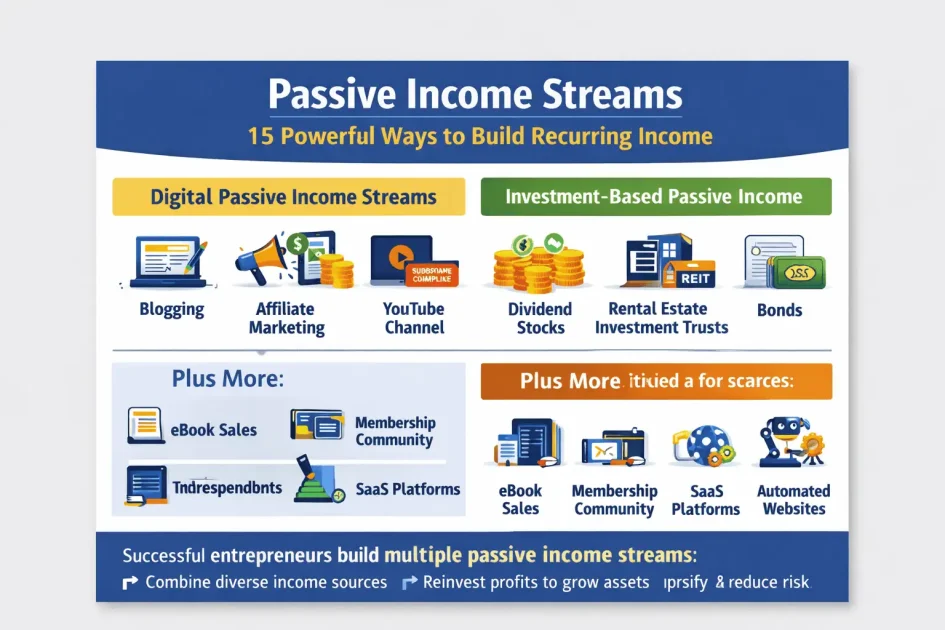
Digital Passive Income Streams
Many modern entrepreneurs focus on digital passive income streams because they require less capital and can scale globally.
Common examples include:
• niche websites
• YouTube channels
• membership communities
• subscription newsletters
• SaaS platforms
Digital income systems can grow into fully structured businesses when supported by strong operational and strategic frameworks.
Investment-Based Passive Income Streams
Investment-driven passive income streams focus on financial assets rather than digital businesses.
Examples include:
• dividend stocks
• bonds
• real estate investment trusts
• private equity funds
These income streams typically require financial capital rather than operational work.
Building Multiple Passive Income Streams
Many successful entrepreneurs intentionally build multiple passive income streams to diversify risk and increase financial stability.
Strategies include:
• combining digital and investment assets
• reinvesting profits into new assets
• scaling existing income systems
As income streams grow, maintaining structure and discipline becomes essential to ensure long-term sustainability and profitability.
Conclusion
Passive income streams provide a powerful way to build long-term financial security by generating income from assets rather than relying solely on active work. By developing systems such as digital businesses, investment portfolios, or real estate income sources, entrepreneurs can create recurring revenue streams that continue producing income over time.
The most successful individuals focus on building multiple passive income streams, gradually expanding their income assets and reinvesting profits to increase long-term financial stability.
Frequently Asked Questions About Passive Income Streams
What are passive income streams?
Passive income streams are recurring sources of revenue generated from assets or systems that require little ongoing effort after the initial setup.
What are the best passive income streams?
Some of the best passive income streams include blogging, affiliate marketing, dividend investing, rental properties, and digital product businesses.
How many passive income streams should you have?
Many entrepreneurs aim to build multiple passive income streams to diversify their income sources and increase financial stability.
Can beginners create passive income streams?
Yes. Beginners often start with digital passive income streams such as blogging, affiliate marketing, or digital products because they require relatively low startup costs.
What returns can you expect from passive income streams?
Returns vary significantly by stream and capital invested. Dividend portfolios yield 3 to 8% annually — a $100,000 portfolio at 5% generates $5,000 per year with no active involvement. Rental property generates $200 to $500 per month net cash flow per door in most markets, representing an 8 to 12% cash-on-cash return on a typical 20% down payment. Affiliate content sites earning $2,000 to $10,000 per month at scale represent a return of hundreds of percent on the time and minimal capital invested during the build phase. Online courses and digital products generate $1,500 to $5,000 per month per product at scale with near-zero ongoing cost. The most efficient passive income streams, measured by income per hour of ongoing maintenance, are dividend investments, licensing royalties, and established digital product businesses.