The internet has fundamentally changed what it means to earn a living. What once required a physical storefront, a fixed schedule, or a single employer can now be built from a laptop, scaled globally, and structured entirely around your own terms. Millions of people are making money online today not as a side experiment, but as their primary income source.
The challenge is not whether it is possible. The challenge is knowing which models are legitimate, which ones match your skills and situation, and how to build something that lasts beyond the first few hundred dollars.
This guide breaks down exactly how to make money online not with vague promises, but with a structured look at the business models, income types, and practical pathways that produce consistent, scalable results.
What Does It Mean to Make Money Online?
Making money online means generating income through internet-based activities, businesses, or assets including freelance services, digital products, content platforms, e-commerce, and investment income streams that operate independently of a fixed employer or physical location.
Online income is not a single category. It spans everything from a freelancer billing a client for one hour of work to an affiliate marketer earning commissions while asleep. The models differ dramatically in how much time they require, how much capital they need, how quickly they generate income, and how far they can scale.
Understanding those differences is the most important thing a beginner can do before choosing a path. Most people fail online not because the model does not work, but because they chose a model that does not match their constraints.
The Four Income Types Behind Every Online Business
Before looking at specific methods, it helps to understand the structural categories that all online income falls into. This framework determines how scalable any given method actually is and what its ceiling looks like.
The four income types are not equally fast to build, equally passive, or equally suited to every starting point. Visualizing how they differ on those dimensions is the clearest way to choose your entry point and plan your next stage.
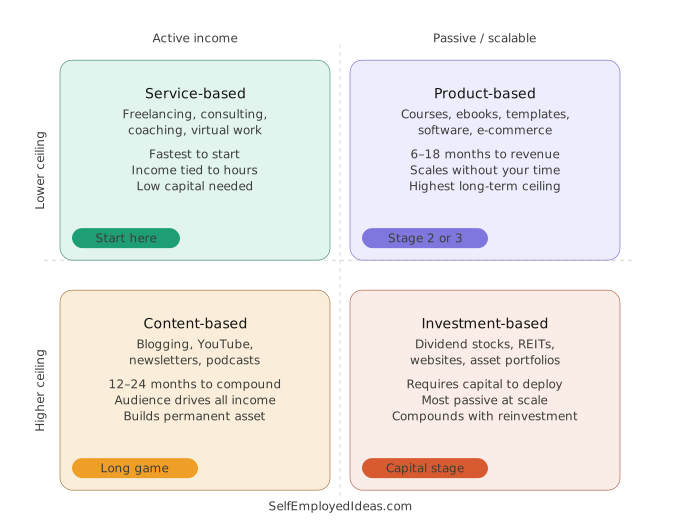
Notice that service-based income sits at the active end of the spectrum but requires the least capital to start which is exactly why it makes the best first stage for most people building online income from scratch. Use it to fund the move into the quadrants above it.
Active Service Income
You perform a task or deliver a service and get paid directly for that effort. Freelance writing, virtual assistance, consulting, and tutoring all fall here. Income is immediate but capped by your available hours. This is where most people start because the barrier to entry is low and the feedback loop is fast.
Product and Transaction Income
You sell something either a physical product, a digital product, or access to a platform and earn a margin or a fee. E-commerce stores, digital downloads, online courses, and software products all operate on this model. Income scales with sales volume rather than hours worked, which raises the ceiling significantly.
Commission and Referral Income
You facilitate a transaction between a buyer and a seller and earn a percentage or flat fee when the transaction completes. Affiliate marketing is the primary example. You do not own the product, handle fulfillment, or manage customer service. You own the audience and the content that connects them to the product.
Asset-Based Income
You own a digital asset, a content platform, a website, a YouTube channel, an email list that generates income repeatedly without requiring proportional new effort. Display advertising, sponsorship, licensing, and recurring subscriptions all belong here. This is the most genuinely passive form of online income, and it is also the slowest to build.
Most successful online income strategies combine multiple types over time. You start with active service income to generate cash quickly, use that cash to build a product or content asset, and eventually layer in commission and asset-based income as the platform grows.
9 Proven Ways to Make Money Online
The methods below are organized from fastest income to longest build time. All of them are legitimate, all of them work, and all of them have produced full-time income for real people. The right choice depends on your skills, your available time, and your tolerance for delayed gratification.
1. Freelancing
Freelancing is the fastest path from zero to online income. If you have a marketable skill — writing, design, development, marketing, video editing, data analysis, bookkeeping — you can sell that skill directly to businesses and individuals who need it done without hiring a full-time employee.
The economics are straightforward. A freelance writer charging $0.10 per word and producing 3,000 words per day earns $300 per day. A freelance web developer billing $75 per hour and working 6 billable hours per day earns $450 per day. A freelance social media manager with five clients at $500 per month each earns $2,500 per month with no additional hourly commitment.
The limitation is also clear: your income is directly tied to your hours. You cannot earn more than the hours you work multiplied by your rate. This is why experienced freelancers eventually move toward productized services, retainers, or digital products that decouple income from time.
The fastest way to start freelancing is to identify your most marketable skill, create a simple portfolio showing what you can do, and begin outreach on platforms like Upwork, Fiverr, or LinkedIn. First clients typically arrive within two to four weeks for people who approach this methodically.
2. Selling Digital Products
Digital products are the highest-margin business model available online. You create something once — a template, an ebook, a course, a design pack, a Notion system, a set of Lightroom presets and sell it an unlimited number of times with no additional production cost.
The range of what people buy is much wider than most beginners assume. A $15 resume template. A $49 email marketing course for small restaurant owners. A $97 financial planning spreadsheet for freelancers. A $297 video course on how to pass a specific certification exam. None of these require technical expertise to build, and all of them have existing markets with real demand.
The key to success with digital products is specificity. A generic productivity course competes with thousands of alternatives. A productivity system designed specifically for nurses working rotating shifts addresses a precise problem for an underserved audience. Narrow products in narrow niches consistently outsell broad products in broad markets.
Platforms like Gumroad, Payhip, and Etsy remove all technical barriers to selling. You can list a product and accept payments within a day. The income compounds as your catalog grows and as the product pages accumulate organic search traffic over time.
3. Affiliate Marketing
Affiliate marketing earns you a commission every time someone purchases a product through your referral link. You do not create the product, handle customer support, or manage fulfillment. You create content that connects people who have a problem with the product that solves it, and earn a percentage of every sale that results.
Commission rates vary significantly by product type. Physical products through Amazon Associates typically pay 1-8%. Software subscriptions through affiliate networks often pay 20-40%. Online courses and digital products commonly pay 30-50%. High-ticket financial or business products can pay $100-500 per referral on a single transaction.
The model works through content. A blog post that ranks on Google for a specific product comparison query generates passive commissions every day from the organic traffic that arrives without ongoing effort. A YouTube video reviewing a piece of software continues earning affiliate income for years after it was filmed. An email newsletter that recommends a product once per month to a list of 5,000 engaged subscribers produces predictable monthly commission revenue.
The build time for affiliate marketing ranges from three months (if you already have an audience) to eighteen months (if you are starting from zero and building organic search traffic). The payoff, once the content asset matures, is income that arrives without daily effort. For a complete breakdown of specific affiliate models and how to build them, the Passive Income Ideas guide covers the full comparison of models by income potential and timeline.
4. Content Creation and Monetization
Content creation encompasses blogging, YouTube, podcasting, newsletters, and social media platforms that pay creators directly or enable indirect monetization through sponsorships, affiliate marketing, and product sales.
YouTube Partner Program requires 1,000 subscribers and 4,000 watch hours before ad revenue begins. Once achieved, RPM rates revenue per thousand views vary from $2-5 in broad entertainment niches to $15-40 in personal finance, business, and professional development niches. A channel averaging 100,000 views per month in a high-CPM niche earns $1,500-4,000 per month in ad revenue alone, before counting sponsorships or affiliate income.
Newsletters have become one of the most direct and high-value content monetization paths. A Substack newsletter with 10,000 free subscribers can generate $3,000-10,000 per month through a combination of paid subscriptions, sponsorships, and affiliate recommendations. The direct relationship with subscribers and the absence of algorithm dependence makes newsletters unusually durable income assets.
Blogging through SEO remains the most scalable content model for most niches because organic search traffic is free, compounding, and intent-based. A reader who finds an article by searching for a specific question is far more likely to take action than a passive social media user who encounters the same content in a feed. The income timeline is long typically twelve to twenty-four months before meaningful traffic but the resulting asset produces income for years with minimal maintenance.
5. Online Courses and Coaching
Online courses are among the highest-revenue digital products available because they solve high-value problems and command premium pricing. A well-positioned course in a commercial niche, career advancement, business skills, financial literacy, professional certification routinely sells for $200-2,000. A course with 100 sales per month at $297 generates $29,700 per month in revenue.
The common misconception about online courses is that you need to be a recognized expert before creating one. You do not. You need to know more than the specific audience you are teaching, and you need to be able to organize that knowledge into a structured learning path that produces a clear outcome. A person who successfully navigated a complex visa application process knows more than someone trying to do it for the first time. That knowledge gap is sufficient to build a valuable course.
Online coaching is the service version of the same model. Rather than delivering knowledge through a pre-recorded product, you deliver it through direct engagement, weekly calls, email support, accountability check-ins. Coaching commands higher prices than courses because it provides personalization, but it also requires more of your time. Many successful creators combine both: a self-paced course at a lower price point and a coaching program at a higher price point for people who want direct support.
6. E-Commerce and Print-on-Demand
E-commerce is selling physical or digital products through an online store, one of the most established online income models, and it encompasses a wide range of approaches at different capital and complexity levels.
Dropshipping allows you to list and sell products without holding inventory. When a customer places an order, the supplier ships directly to them. Your margin is the difference between what the customer paid and what the supplier charges. The model requires minimal upfront capital but demands strong marketing skills, since the products you sell are often available elsewhere and margin pressure is constant.
Print-on-demand is a variant where custom designs are printed on products, t-shirts, mugs, tote bags, phone cases only after purchase. Platforms like Redbubble, Merch by Amazon, and Printful handle production and fulfillment entirely. Your only job is to create designs and list them. The income compounds as the design catalog grows, and the truly passive nature of the model makes it one of the most accessible starting points for people with creative skills and limited time.
Private label e-commerce sourcing products and selling them under your own brand, typically through Amazon FBA requires significantly more capital but produces higher margins and a defensible brand position. This is a longer-term business building path rather than a quick income strategy.
7. Remote Work and Online Employment
Not every form of making money online involves running a business. Fully remote employment has expanded dramatically, and for many people, a remote job is the most direct path to reliable online income without the uncertainty of entrepreneurship.
High-demand remote roles include software development, UX design, digital marketing, content strategy, customer success management, data analysis, and technical writing. These positions offer full employment benefits, predictable salary income, and the ability to work from anywhere with a reliable internet connection.
Many people use remote employment as the stable income foundation that funds a parallel online business during off-hours. This parallel approach employed by day, building an online business in the margins is how a substantial percentage of successful online business owners actually got started. The employment provides financial stability; the business provides the long-term upside. For a structured overview of remote work categories and how they connect to broader income systems, the Work From Home Jobs guide covers the full landscape.
8. Stock Assets and Licensing
Creators with skills in photography, videography, illustration, music composition, or font design can generate passive income by licensing their work through stock asset platforms. Shutterstock, Getty Images, Adobe Stock, Pond5, and similar platforms pay royalties each time a customer downloads your asset.
The income from stock assets is genuinely passive once uploaded, your library works for you continuously without additional effort. The challenge is volume: individual asset payouts are modest, typically $0.25-4 per download depending on the platform and the asset type. Building meaningful monthly income requires a catalog of hundreds or thousands of assets. Creators who treat stock licensing as a consistent output habit uploading regularly over one to three years typically reach $500-3,000 per month in passive royalty income from their accumulated catalog.
9. Investing and Dividend Income Online
Online brokerage platforms have made investment-based passive income accessible at lower capital thresholds than ever before. Fractional share investing allows dividend income from $1. High-yield savings accounts and money market funds offer meaningful interest rates with zero risk and immediate liquidity. REITs aka Real Estate Investment Trusts provide exposure to real estate income without the capital requirements of property ownership.
Investment-based online income is not a starting point for most people because it requires capital that most beginners do not yet have. It is, however, the natural destination for income generated through other online methods. Successful online business owners consistently redirect profits into income-producing assets, transforming active business income into compounding passive income over time. For the complete framework on building passive income through investments and other asset-based models, the Passive Income and Wealth guide covers the full system architecture.
How to Make Money Online: Comparison Table
| Method | Startup Cost | Time to First Income | Income Ceiling | Passivity at Scale | Best For |
|---|---|---|---|---|---|
| Freelancing | $0 | 1-4 weeks | Medium | Low | Fast income, skill monetization |
| Digital Products | $0-100 | 1-8 weeks | High | Very High | Creators, educators |
| Affiliate Marketing | $50-200 | 3-18 months | Very High | Very High | Content creators, writers |
| Content Creation | $0-500 | 6-24 months | Very High | High | Communicators, educators |
| Online Courses | $0-500 | 1-6 months | Very High | High | Experts, educators |
| E-Commerce | $0-5,000+ | 1-6 months | Very High | Medium-High | Product sellers, designers |
| Remote Work | $0 | 2-8 weeks | Medium | Low | Stability seekers |
| Stock Licensing | $0-200 | 6-24 months | Medium | Very High | Photographers, designers |
| Investment Income | $500+ | Immediate | Unlimited | Highest | Capital deployers |
How to Choose the Right Method for Your Situation
The comparison table shows the landscape, but choosing well requires honest self-assessment on four variables that determine which method fits your actual situation rather than your aspirational situation.
Every durable online income system follows the same underlying sequence, even when the specific models differ. Skipping stages is the most common reason people spend years experimenting without building anything that lasts.
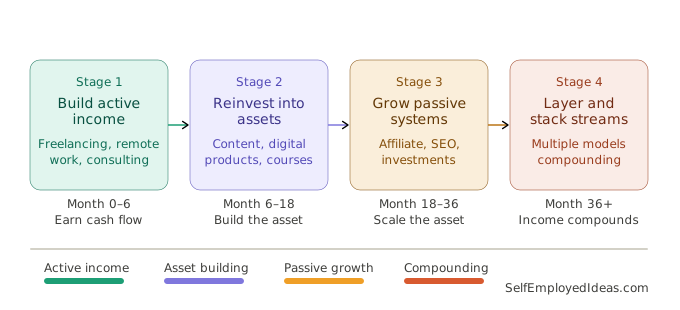
The timeline compresses or extends based on how consistently you execute each stage but the order almost never changes. Active income first. Reinvestment second. Passive systems third. This is not a theory. It is the pattern behind virtually every online income success story told without the marketing gloss.
How quickly do you need income?
If you need income within the next thirty days, your options are freelancing and remote work. Nothing else generates reliable income that fast. Affiliate marketing, content creation, and digital products can theoretically produce early income, but not reliably and not on short timelines for most beginners.
If you have six to twelve months of financial runway, you have the flexibility to build something with a longer compounding curve a content site, a digital product catalog, a YouTube channel that will produce much higher income per hour invested once it matures.
What skills do you currently have?
Writing, design, development, marketing, teaching, analysis, and domain expertise in any field are all directly monetizable online. The question is not whether your skills are valuable, it is which monetization model extracts the most value from them most efficiently.
A skilled writer can freelance immediately, start an affiliate blog, or build an email newsletter, three very different income paths with very different timelines and ceilings. A designer can freelance, sell templates, create a print-on-demand store, or license assets to stock platforms. The skill opens multiple doors; the choice of which door to walk through depends on the other variables.
How many hours per week can you genuinely commit?
Five hours per week supports a digital template store or a print-on-demand shop maintained at slow growth. Ten to fifteen hours per week supports serious freelancing or a steadily growing content platform. Twenty or more hours per week, the equivalent of a dedicated part-time commitment opens every option on the list.
The most common mistake is choosing a model that requires twenty hours per week while only having five available, then concluding the model does not work when progress stalls. The model works. The constraint is time. For a full breakdown of how time constraints map to specific entry points, the Passive Income for Beginners guide covers how to match your available time to the right starting model.
Do you want to build a business or earn income?
These are not the same goal, and they lead to different choices. Earning reliable income as quickly as possible points toward freelancing and remote work. Building a scalable business that eventually operates without your daily involvement points toward digital products, content platforms, and affiliate marketing.
Neither goal is superior. Many people who started building a business eventually decided that freelancing at a high rate was a better lifestyle fit. Many people who started freelancing eventually pivoted to building a product business because they wanted income that did not stop when they stopped working. The important thing is to be clear about which goal you are actually optimizing for, because the strategies are genuinely different. For the full framework on how self-employment income models are structured, the Self Employment Models guide covers the complete architecture.
The Five Mistakes That Stop Most People From Making Money Online
The failures are consistent enough across different online income models that they are worth naming explicitly. Most people who try to make money online and do not succeed are stopped by one or more of these five patterns.
Mistake 1: Switching methods before one has time to work
Every online income method has a timeline that extends longer than most beginners expect. Affiliate marketing takes six to eighteen months to produce meaningful traffic. A freelance client base takes four to eight weeks to establish. An e-commerce store takes two to six months to find product-market fit. The people who succeed are not the ones who find a faster method, they are the ones who stay consistent with a single method long enough for the compounding to begin.
Mistake 2: Choosing a method based on ceiling rather than fit
Affiliate marketing has a higher income ceiling than freelancing, but a freelancer who is working consistently earns more than an affiliate marketer who started a blog and abandoned it at month three. The highest-ceiling method is worthless if you cannot sustain the execution required to reach the ceiling. Choose based on fit, time availability, skill match, tolerance for delayed gratification and not based on maximum theoretical income.
Mistake 3: Building before validating
Spending three months building a digital course before confirming that anyone will pay for it is one of the most common and expensive mistakes in online income. The validation can be simple: post about the topic and gauge response, send a survey to potential buyers, or pre-sell the product before building it. Validation takes days. A wasted three-month build takes three months. Do the days first.
Mistake 4: Confusing complexity with effectiveness
The most elaborate setup, the perfectly branded website, the complex funnel, the sophisticated automation is rarely what produces the first income. A simple Gumroad product listing outperforms an elaborate course platform that was never finished. A straightforward email to a potential freelance client outperforms a polished portfolio website that delayed the outreach by two weeks. Simplicity generates momentum. Complexity generates delays. Optimize for starting, not for perfecting.
Mistake 5: Treating online income as passive from day one
Every passive income model has an active build phase that precedes the passive phase. Affiliate marketing requires months of active content creation before traffic arrives passively. Digital products require active marketing before passive sales compound. Stock asset libraries require months of active uploading before passive downloads reach meaningful volume. People who expect passive income immediately and experience active effort instead often conclude the model is a scam. It is not. The active phase is the price of the passive phase that follows.
How to Start Making Money Online This Week
The practical starting path depends on which method you are pursuing, but the first week looks similar across all of them: identify, set up, and initiate. Not research for another month. Not plan further. Identify, set up, and initiate.
For freelancing: identify your most marketable skill, set up a profile on Upwork or reach out directly to five potential clients via LinkedIn, and send at least three proposals or messages before the week ends. The first client rarely comes from the first message. It comes from the eighth or tenth. Start the count.
For digital products: identify one specific problem you can solve for one specific audience, build the simplest possible version of the solution, and list it on Gumroad or Etsy. A single template or checklist, well-described and priced at $10-25, is a better starting point than a comprehensive course that will take six months to build.
For affiliate content: choose one topic you know well, identify two or three products in that space with affiliate programs, write a genuinely useful comparison or review article, and publish it. One article is not a content strategy, but it is a start. Every piece of content you publish is a compounding asset. The portfolio starts with the first piece.
For side hustles and additional income ideas to combine with any of the above, the Side Hustle Ideas guide covers the full range of options with timelines, income expectations, and starting steps for each. For the complete picture of how online income connects to longer-term financial independence, the How to Become Self Employed guide covers the full transition from first income to sustained independence.
Conclusion
Making money online is not a single path. It is a decision about which of several legitimate, proven models fits your skills, your available time, your income timeline, and your longer-term goals. The models that work are well-documented. The people who succeed are not those who found a secret, they are the ones who chose a model and stayed consistent long enough for it to compound.
The most important step is the first one: choose a method, begin this week, and do not switch until you have given it the time it genuinely requires. Every major online income story started with exactly that decision.
Frequently Asked Questions About How to Make Money Online
What is the fastest way to make money online?
Freelancing is the fastest legitimate path to online income for most people. Someone with a marketable skill, writing, design, development, marketing, bookkeeping can identify clients, send proposals, and earn their first payment within one to four weeks. No other online income method produces reliable first income that quickly for beginners starting from zero.
Can you make money online with no money to start?
Yes. Freelancing, remote work, and affiliate content on free platforms require no financial investment to start. Digital products can be listed on platforms like Gumroad with no upfront cost. Print-on-demand stores on Redbubble and similar platforms have no startup fees. The models that require capital private label e-commerce, paid advertising, investment income are not necessary starting points, and none of them are the right first step for someone starting with zero capital.
How long does it take to make money online consistently?
It depends on the method. Freelancing typically produces consistent income within one to three months of committed effort. Digital product sales typically reach consistency within three to six months. Affiliate marketing and content-based income typically take six to eighteen months to reach consistency. Investment income is immediate once capital is deployed but requires capital to generate meaningful amounts. The shortest timeline for any method is measured in weeks, not days, and the longest is measured in years, not months.
Is it realistic to make a full-time income online?
Yes. Millions of people earn their primary income online through freelancing, digital products, content platforms, e-commerce, remote employment, and combinations thereof. Full-time online income is not exceptional, it is the norm for a significant and growing segment of the workforce. The realistic timeline for replacing a full-time salary through online business, starting from zero, is typically one to three years of consistent part-time effort. It is achievable, but it is not fast, and it is not passive in the early stages.
What is the best way to make passive income online?
Affiliate marketing through a content platform and digital product sales are the most accessible paths to genuine passive income for people starting without significant capital. Both require substantial upfront work building a content asset or creating and marketing a product but both can eventually generate consistent revenue without daily effort. For people with capital to deploy, dividend investing and high-yield savings provide immediate passive income. The specific model that is best depends on your skills, your timeline, and your available capital. The Passive Income Ideas guide provides a complete comparison of all major models with income ranges and startup requirements.
What skills do you need to make money online?
Nearly any skill is monetizable online. Writing, design, development, marketing, teaching, consulting, analysis, photography, video production, and domain expertise in any professional field all have clear online income paths. For people without obvious marketable skills, writing, social media management, and basic administrative virtual assistance are all learnable in weeks and immediately monetizable through freelancing platforms. The absence of skills is not a barrier it is a starting point. Most successful online earners learned the skills they monetize through the process of monetizing them, not before.