Most businesses treat marketing as promotion and growth as expansion.
Institutionally, they are capital allocation systems.
Marketing determines demand generation efficiency.
Growth determines how efficiently demand converts into scalable, repeatable revenue.
Without marketing architecture, revenue is unpredictable.
Without growth systems, revenue does not compound.
This guide breaks marketing and growth into structural pillars that determine whether a business remains dependent on sporadic sales or evolves into a scalable revenue engine.
We analyze:
• Authority positioning
• Traffic acquisition systems
• Conversion mechanics
• Revenue expansion frameworks
• Retention infrastructure
• Scalable growth architecture
Growth is not a tactic. It is a structured system designed to convert demand into scalable and repeatable revenue.
These systems support all self employment models, where revenue depends on structured customer acquisition and conversion.
What Is Marketing & Growth?
Marketing and growth are integrated revenue systems designed to attract demand, convert prospects, increase customer lifetime value, and scale business valuation through structured acquisition, optimization, and retention architecture.
How Marketing & Growth Systems Work
Marketing and growth systems operate as a structured revenue engine that transforms attention into predictable and scalable income. Rather than relying on isolated tactics, these systems integrate demand generation, conversion optimization, and retention into a cohesive framework.
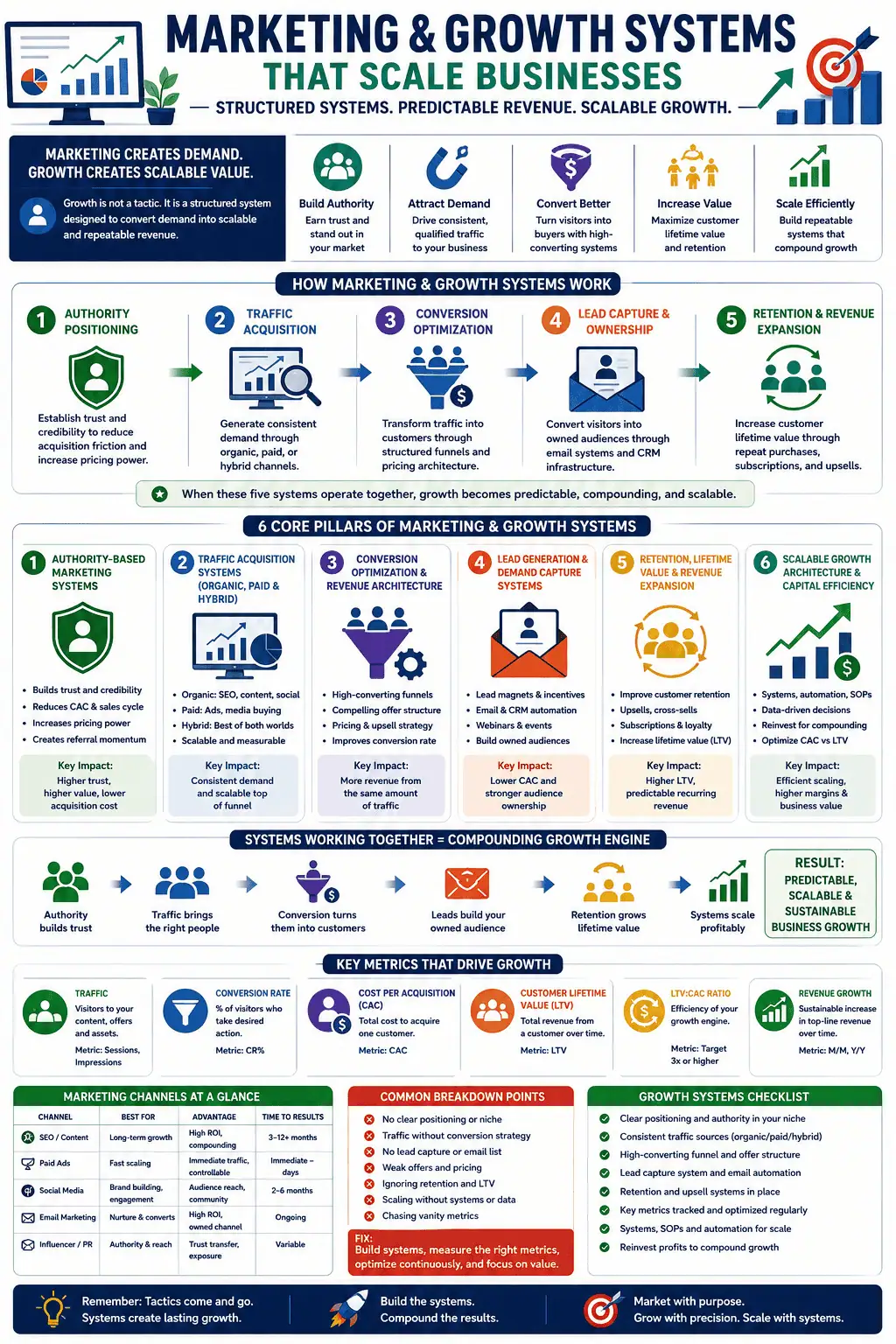
At a structural level, growth follows five core stages:
1. Authority Positioning
Establish trust and credibility to reduce acquisition friction and increase pricing power.
2. Traffic Acquisition
Generate consistent demand through organic, paid, or hybrid channels.
3. Conversion Optimization
Transform traffic into customers through structured funnels and pricing architecture.
4. Lead Capture & Ownership
Convert visitors into owned audiences through email systems and CRM infrastructure.
5. Retention & Revenue Expansion
Increase customer lifetime value through repeat purchases, subscriptions, and upsells.
When these systems operate together, growth becomes predictable rather than reactive.
1. Authority-Based Marketing Systems
System Role
Authority-based marketing is a positioning strategy where trust, expertise, and credibility reduce acquisition friction and increase pricing power.
It shifts marketing from persuasion to pre-sold demand.
Authority acts as an economic moat.
Revenue Mechanics
Authority reduces:
• Customer acquisition cost (CAC)
• Sales cycle length
• Objection resistance
• Price sensitivity
It increases:
• Conversion rate
• Referral frequency
• Brand equity
• Valuation multiple
Businesses without authority compete on price.
Businesses with authority compete on trust.
Trust compresses friction.
Practical Scenario 1: Niche Industry Consultant
A cybersecurity consultant publishes in-depth compliance frameworks.
Instead of cold outreach:
• Prospects arrive pre-qualified
• Pricing increases 40%
• Sales conversations shorten
Authority reduces acquisition effort.
Revenue per client increases without volume expansion.
Scaling Scenario 2: Founder-Led Brand
A founder builds a long-form educational content platform.
Over time:
• Organic traffic compounds
• Media interviews increase
• Partnerships become inbound
Marketing shifts from active pursuit to authority gravity.
Customer acquisition becomes system-driven.
Common Breakdown Points
Businesses misunderstand authority as:
• Social media posting
• Vanity metrics
• Generic content
Without specialization and depth:
Authority does not compound.
Content without positioning creates noise.
Noise does not reduce CAC.
Strategic Refinement
To build authority systems:
• Define a narrow niche
• Publish institutional-level content
• Develop proprietary frameworks
• Build proof assets (case studies)
• Secure earned media or speaking exposure
• Maintain consistency
Authority requires patience and intellectual ownership.
It cannot be rushed through advertising alone.
Growth Impact
Authority increases enterprise value because:
• Revenue becomes less dependent on paid channels
• Brand equity becomes transferable
• Premium pricing stabilizes margins
• Competitive moat widens
In acquisition scenarios, authority reduces volatility risk.
Valuation multiples expand when demand is brand-driven instead of ad-dependent.
Authority is not marketing decoration.
It is revenue leverage.
2. Traffic Acquisition Systems (Organic, Paid & Hybrid Architecture)
Structural Definition
Traffic acquisition systems are structured mechanisms used to generate consistent demand flow into a business. These systems convert attention into measurable audience flow through organic channels, paid distribution, or hybrid strategies.
Traffic is not marketing — it is the input layer of a structured revenue system.
It is the input layer of revenue architecture.
Without structured traffic systems, growth cannot compound.
Economic Logic
Traffic systems determine:
• Volume of opportunities
• Cost per acquisition
• Predictability of revenue
• Speed of scaling
• Risk exposure
Organic systems (SEO, content, YouTube) require time but build long-term asset value.
Paid systems (ads, sponsorships, media buying) generate speed but require capital discipline.
Hybrid systems balance time and capital.
The economics are simple:
Traffic × Conversion Rate × Average Order Value = Revenue
But traffic source determines volatility.
Organic traffic behaves like equity.
Paid traffic behaves like leverage.
Leverage amplifies both gains and losses.
Applied Case Study 1: SEO Asset Strategy
A B2B software company builds long-form educational content.
Over 24 months:
• Organic rankings compound
• Paid ad spend decreases
• Inbound leads increase
• CAC declines
SEO becomes a traffic asset.
Traffic no longer depends on daily ad spend.
The company’s valuation increases due to predictable inbound flow.
Organic traffic behaves like owned infrastructure.
Applied Case Study 2: Paid Acquisition Scaling
An e-commerce brand launches paid social campaigns.
Initial return on ad spend (ROAS) is strong.
They reinvest profit into scaling budget.
Revenue grows rapidly.
However:
• CAC rises
• Ad fatigue increases
• Platform algorithm changes disrupt performance
Without diversification, the system becomes fragile.
Paid traffic offers speed — not stability.
Failure Pattern
Businesses fail in traffic acquisition by:
• Relying solely on one channel
• Scaling ads without backend optimization
• Ignoring lifetime value economics
• Underestimating algorithm volatility
• Treating SEO as short-term
Single-channel dependency increases fragility.
Fragility reduces valuation stability.
Traffic without diversification becomes risk concentration.
Optimization Strategy
To strengthen traffic systems:
• Combine organic and paid channels
• Build owned media assets (email, community)
• Monitor CAC relative to LTV
• Diversify across at least two traffic sources
• Invest in content compounding
• Reinforce authority positioning
Organic builds stability.
Paid builds velocity.
Hybrid builds resilience.
Traffic architecture must reflect capital strategy.
Scaling & Valuation Implications
Investors evaluate:
• Channel diversification
• Customer acquisition cost trend
• Traffic concentration risk
• Organic vs paid ratio
• Sustainability of demand
Businesses heavily reliant on paid traffic receive lower multiples.
Companies with strong organic traffic and owned audience assets command higher valuations.
Traffic predictability equals revenue predictability.
Revenue predictability increases enterprise value.
Traffic is not attention.
It is economic oxygen.
3. Conversion Optimization & Revenue Architecture
System Role
Conversion optimization is the systematic improvement of how traffic transforms into revenue. Revenue architecture defines how offers, pricing, and funnels are structured to maximize margin and lifetime value.
Traffic without conversion is expense.
Conversion without revenue structure is inefficiency.
Revenue architecture determines profitability elasticity.
Revenue Mechanics
Small conversion improvements create exponential revenue impact.
Example:
10,000 visitors
2% conversion → 200 sales
3% conversion → 300 sales
A 1% improvement increases revenue by 50%.
When paired with pricing optimization, impact compounds further.
Conversion systems determine:
• Revenue per visitor
• Cost recovery speed
• Break-even acquisition point
• Margin resilience
Revenue architecture includes:
• Offer structuring
• Pricing psychology
• Upsell mechanics
• Funnel sequencing
• Payment structuring
Conversion is not persuasion.
It is structural friction removal.
Scaling Scenario 1: Funnel Re-Architecture
A SaaS company reduces onboarding friction.
Instead of 7-step signup:
• Simplifies to 3-step
• Adds progress tracking
• Introduces guided setup
Conversion rate increases by 22%.
No new traffic required.
Revenue increases from structural optimization.
Practical Scenario 2: Offer Stack Optimization
A coaching business restructures pricing.
Instead of a single package:
• Adds tiered offers
• Introduces payment plans
• Includes bonus value stacking
Average order value increases 38%.
Revenue growth occurs without new lead generation.
Optimization outperforms acquisition.
Common Breakdown Points
Businesses often:
• Chase traffic before fixing conversion
• Offer unclear value propositions
• Ignore funnel analytics
• Price emotionally, not strategically
• Overcomplicate checkout flows
Optimization is ignored because traffic feels exciting.
But traffic without architecture increases burn rate.
Burn rate reduces survival window.
Strategic Refinement
To strengthen conversion systems:
• Map entire funnel journey
• Identify friction points
• Simplify decision pathways
• Test pricing elasticity
• Introduce upsells strategically
• Monitor drop-off analytics
Conversion improvement compounds across scale.
Optimization is multiplicative leverage.
Growth Impact
High conversion rates:
• Reduce required ad spend
• Improve margin
• Increase lifetime value
• Improve investor confidence
Businesses with optimized revenue architecture demonstrate operational maturity.
Operational maturity increases valuation multiples.
Conversion is margin leverage.
Margin leverage is valuation power.
Strong growth systems rely on solid business foundations, particularly financial discipline and operational structure.
4. Lead Generation & Demand Capture Systems
Structural Definition
Lead generation systems convert anonymous traffic into identifiable prospects through opt-ins, gated assets, or relationship-based entry points.
Traffic is public.
Leads are owned.
Ownership changes economics.
Economic Logic
Businesses with owned leads reduce:
• Platform dependency
• Paid acquisition risk
• Revenue volatility
Email lists and CRM databases become proprietary assets.
Lead capture enables:
• Follow-up automation
• Nurture sequencing
• Retargeting efficiency
• Repeat monetization
Acquiring a lead is cheaper than acquiring a customer repeatedly.
Ownership reduces acquisition redundancy.
Applied Case Study 1: Educational Lead Magnet
A B2B firm offers industry whitepapers.
Lead capture increases database size by 8,000 qualified contacts.
Follow-up campaigns convert 14% over six months.
Lead generation produces deferred revenue.
Applied Case Study 2: Webinar Funnel
A course creator uses webinar funnels.
Traffic converts to registrants.
Registrants convert to buyers.
Lead cost decreases as automation improves.
Revenue becomes predictable through structured demand capture.
Failure Pattern
Common mistakes:
• Capturing leads without segmentation
• Over-emailing
• Failing to nurture
• Relying solely on social followers
• Ignoring CRM integration
Unmanaged lead databases become dormant assets.
Dormancy reduces asset value.
Optimization Strategy
• Segment audiences early
• Personalize messaging
• Automate nurturing sequences
• Track open and click performance
• Remove inactive contacts
Lead quality > lead quantity.
Ownership > exposure.
Scaling & Valuation Implications
Owned audiences:
• Increase acquisition efficiency
• Improve launch revenue
• Enhance investor perception
• Increase strategic buyer interest
Databases are intangible assets.
Assets increase enterprise value.
5. Retention, Lifetime Value & Revenue Expansion
Structural Definition
Retention systems increase the revenue generated per customer over time through repeat purchases, subscriptions, upsells, and loyalty frameworks.
Retention stabilizes growth.
Economic Logic
Increasing customer lifetime value (LTV):
• Reduces dependence on constant acquisition
• Improves CAC efficiency
• Increases margin
• Creates revenue compounding
Retention multiplies acquisition efficiency.
Acquiring once and monetizing repeatedly improves capital efficiency.
Applied Case Study 1: Subscription Layer
An e-commerce brand adds subscription replenishment.
Repeat purchase frequency increases.
Revenue predictability improves.
Retention converts volatility into stability.
Applied Case Study 2: Loyalty Program
A service provider introduces referral incentives.
Customer base grows organically.
Acquisition cost drops 18%.
Retention reduces marketing pressure.
Failure Pattern
Businesses often:
• Ignore post-sale engagement
• Fail to upsell strategically
• Neglect customer experience
• Focus solely on acquisition
High churn increases CAC burden.
Burden reduces scalability.
Optimization Strategy
• Track churn rate
• Improve onboarding
• Create loyalty incentives
• Offer subscription options
• Increase value delivery
Retention is growth insurance.
Scaling & Valuation Implications
Investors evaluate:
• LTV/CAC ratio
• Retention rate
• Revenue predictability
• Subscription share
High retention businesses command higher multiples.
Stability equals valuation expansion.
6. Scalable Growth Architecture & Capital Efficiency
Structural Definition
Scalable growth architecture integrates authority, traffic, conversion, lead capture, and retention into a cohesive system optimized for capital efficiency and long-term expansion.
Economic Logic
Growth must balance:
• Speed
• Risk
• Margin
• Capital deployment
Unstructured growth creates chaos.
Structured growth compounds predictably.
Capital efficiency determines survivability.
Applied Case Study 1: Balanced Growth Model
A SaaS firm integrates:
• Organic content
• Paid acquisition
• Email automation
• Subscription retention
Revenue grows steadily without volatility spikes.
Integration increases resilience.
Applied Case Study 2: Over-Leveraged Expansion
A startup scales ads aggressively.
Without retention systems:
• CAC increases
• Churn rises
• Cash flow collapses
Growth without architecture is fragility.
Failure Pattern
• Scaling before optimization
• Ignoring cash flow timing
• Overreliance on one channel
• Expanding without infrastructure
Growth amplifies weaknesses.
Optimization Strategy
• Sequence scaling phases
• Build backend systems first
• Monitor capital allocation
• Maintain cash reserves
• Diversify acquisition channels
Scale should follow stability.
Scaling & Valuation Implications
Integrated growth systems:
• Increase predictability
• Improve investor confidence
• Support acquisition readiness
• Expand enterprise multiples
Growth without system reduces valuation.
Growth with architecture increases equity value.
Many businesses use these systems to build passive income strategies that scale beyond active work.
Final Growth Perspective
Marketing and growth are not promotional activities.
They are revenue infrastructure.
Authority reduces acquisition friction.
Traffic generates opportunity.
Conversion multiplies revenue.
Lead capture builds ownership.
Retention compounds long-term value.
Businesses that treat growth as isolated tactics remain unstable.
Businesses that engineer growth systems build scalable, predictable revenue.
Marketing creates visibility.
Growth creates structure.
Together, they define enterprise trajectory.
Marketing is visibility.
Growth is structured expansion.
Together, they define enterprise trajectory.
FAQ
What is the difference between marketing and growth?
Marketing generates demand. Growth integrates acquisition, conversion, and retention into scalable revenue systems.
Is organic traffic better than paid traffic?
Organic traffic builds long-term assets. Paid traffic offers speed. The strongest systems combine both.
What is the most important growth metric?
Customer Lifetime Value relative to Customer Acquisition Cost determines sustainability.
Why is retention critical for growth?
Retention reduces acquisition pressure and increases revenue stability.