Quick Definition: Starting a business with no money means launching with services rather than products, using free or low-cost tools, registering as a sole proprietor for as little as $60, and reinvesting your first earnings to grow rather than borrowing or spending upfront. The path is not effortless, but in 2026 the financial barrier to starting a business in Canada is lower than it has ever been.
Introduction
“How to start a business with no money” is one of the most searched small business questions for a reason. Most people who want to start something do not have a spare $10,000 sitting around for branding, inventory, or a fancy website. They have an idea, some time, and a skill or service they think people would pay for.
The good news is that the gap between “I have an idea” and “I have a paying client” has never been smaller. Free website builders, no-code tools, social media platforms, and digital payment processors have collapsed most of the costs that used to be unavoidable. The Canadian government also makes basic business registration genuinely cheap: a sole proprietorship in Ontario costs $60 and a Business Number from the CRA is free.
That said, “no money” does not mean “no effort.” Starting a business with no money means trading money for time, hustle, and a willingness to start small and reinvest. Service-based businesses, where you are the product, are almost always the fastest path to revenue because they require no inventory, no manufacturing, and no upfront purchase before you can get paid.
This guide walks through exactly how to go from zero to your first paying client without spending money you do not have.
How Can You Start a Business With No Money?
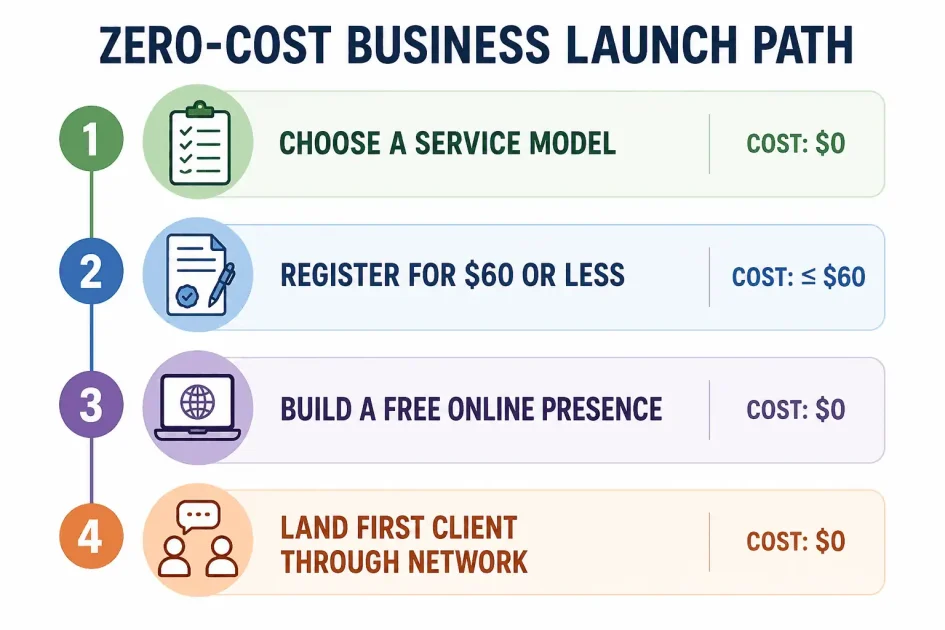
The short answer: pick a service-based business model where your skill or time is the product, use free tools to set up the basics (a simple website, social presence, and payment processing), find your first client through your existing network, and reinvest your first earnings into the tools and improvements that help you grow. Registration costs are minimal (around $60 in most Canadian provinces) and can often be deferred until you have your first paying client.
The longer answer covers each of these steps in detail below.
Step 1: Choose a Business Model That Requires No Upfront Investment
The single biggest factor in starting a business with no money is choosing the right type of business. Some business models are simply impossible to start without capital. A retail store needs inventory and a lease. A restaurant needs equipment and a location. A manufacturing business needs materials and machinery.
Service-based businesses avoid all of that. If your “product” is your time, expertise, or skill, there is nothing to purchase before you can deliver it. You get paid, then you deliver. This is the opposite of inventory-based businesses, where you have to spend before you can sell.
Examples of service-based businesses that require essentially zero startup capital include freelance writing, graphic design, virtual assistance, social media management, bookkeeping, tutoring, consulting in an area of existing expertise, web design using free or low-cost tools, and skilled trade work using tools you may already own.
Digital products are the second-best option. An ebook, a Canva template, a digital course, or a set of printables can be created with free tools and sold repeatedly without per-unit costs. The upfront investment here is time rather than money, but once created, digital products generate revenue with no ongoing production cost.
Affiliate marketing and dropshipping are often pitched as no-money business models, and technically they can be started for close to zero dollars. But both require an audience or significant marketing effort before they generate meaningful income, and they tend to have a longer runway to first revenue than direct services. For someone trying to start a business with no money and needs income sooner rather than later, services are the more reliable starting point.
Step 2: Register Your Business (It Costs Almost Nothing)
One of the most persistent myths about starting a business is that registration is expensive or complicated. In Canada, it is neither.
For most provinces, registering a sole proprietorship costs between $60 and $100. In Ontario, registering a business name through the Ontario Business Registry costs $60 and the registration is valid for five years. A Business Number from the CRA, which you need for tax purposes and to charge GST/HST once you cross the threshold, is free.
If you are operating under your own legal name (for example, “Jane Smith” rather than “Jane Smith Consulting”), some provinces do not require registration at all. Newfoundland and Labrador, for instance, does not require sole proprietors or partnerships to register their business names if they operate under their own legal name. Check your specific province’s requirements before assuming registration is mandatory.
GST/HST registration is not required until your revenue exceeds $30,000 in four consecutive calendar quarters, so most people starting out do not need to worry about this in the first months. Voluntary early registration can actually be beneficial if you are making significant purchases, since it lets you claim input tax credits on the GST/HST you pay on business expenses.
The practical takeaway: registration cost is not the barrier. If $60 is genuinely out of reach, many provinces allow you to delay registration until after you have landed your first paying client and have the funds from that work to cover it.
Step 3: Build a Minimal Online Presence for Free
You do not need a custom website, a logo designed by a professional, or a marketing budget to start. You need to be findable and credible enough that a potential client takes you seriously.
A free or low-cost website builder (many offer free tiers or trials) can get a simple one-page site live in an afternoon. For service-based businesses, this page needs to communicate three things clearly: what you do, who you do it for, and how to contact you. That is the entire job of the page in the early stages.
A complete LinkedIn profile, for service businesses targeting other businesses, often does more work than a website in the first few months. It is free, it is where potential clients are already looking, and it allows for direct outreach and connection-building without any cost.
For consumer-facing businesses, a focused presence on the platform where your audience actually spends time, Instagram, TikTok, Facebook, depending on your market, matters more than a polished website. Posting consistently and engaging genuinely costs nothing but time.
Design tools like Canva offer free tiers that are more than sufficient for creating social media graphics, simple logos, and basic marketing materials in the early stages. Professional branding can come later, once revenue justifies the investment.
Step 4: Get Your First Client Without Spending on Marketing
This is the step where most “start a business with no money” guides get vague, because it is genuinely the hardest part. But it is also the most learnable part, and it does not require an advertising budget.
Start with your existing network. Former colleagues, friends, family, and professional contacts are your warmest leads by a significant margin. They already know you, which means they already trust your work in a way a stranger does not. Telling people directly what you are doing, rather than hoping they notice a social media post, is far more effective than most people expect.
Offer a smaller version of your service to reduce the decision barrier. A first client is often easier to land with a smaller, lower-risk offer: a single piece of content instead of a full content strategy, a one-page audit instead of a full consulting engagement. This gets your foot in the door and gives you a real result to point to for the next client.
Use free directories and community platforms relevant to your field. Many industries have free listing directories, local business groups, and online communities where people post requests for the exact services you offer. These require time to find and engage with, but no money.
Document everything from your first project. Your first client, even if the engagement is small or discounted, becomes your first testimonial, your first case study, and often your first referral source. Treat the first project as an investment in proof, not just income.
Step 5: Use Your First Revenue to Reinvest, Not to Spend
Once money starts coming in, the temptation is to treat it as income to spend personally or to immediately upgrade everything: a better website, paid advertising, new equipment. Resist that instinct in the early months.
The most effective use of early revenue is reinvestment into things that directly increase your capacity to earn more. This might mean a paid tool that saves you significant time (an invoicing platform, a design subscription, project management software), a course or certification that lets you raise your rates or take on higher-value work, or basic professional services like a part-time bookkeeper once volume justifies it.
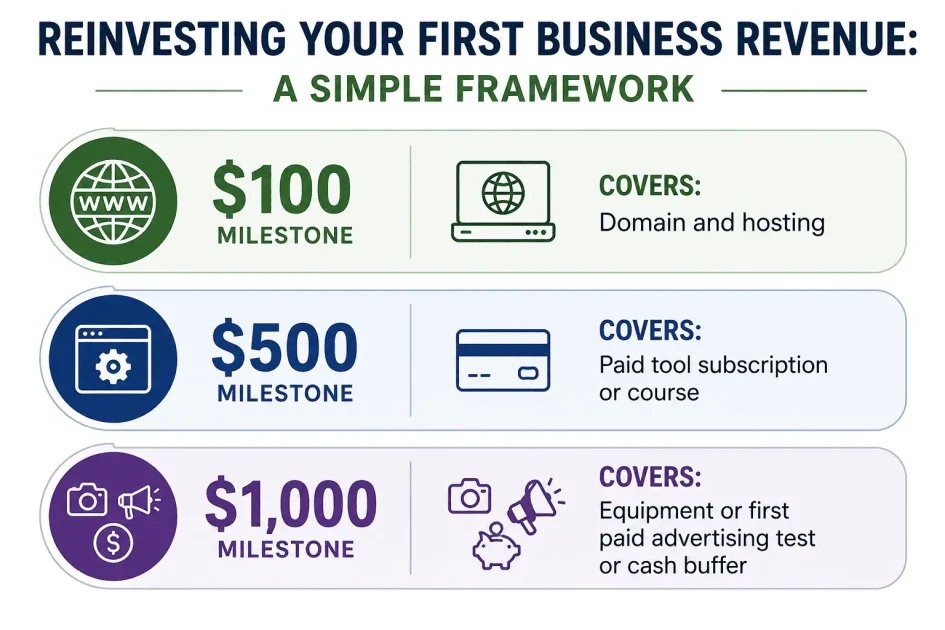
A useful framework: your first $100 in profit might go toward a domain name and basic website hosting if you have not already covered that. Your first $500 might fund a paid tool subscription or a small course. Your first $1,000 gives you real options: better equipment, your first paid advertising test, or simply a cash buffer that reduces the pressure on the next client decision.
The discipline of reinvesting early profit rather than spending it is what separates a business that compounds from a side project that stays small. It also builds the habit of treating the business as a business, with its own finances, from the very beginning. Setting up a separate bank account for business income, even before you have formally registered, makes this separation concrete and makes tax time considerably easier. For more detail on the tax side of things, the self-employment tax guide for Canada covers what to expect once income starts flowing in regularly.
What “No Money” Actually Means in Practice
It is worth being honest about what starting a business with no money really involves, because the framing can be misleading if taken too literally.
“No money” generally means no significant upfront capital, not literally zero dollars ever. Most people starting this way will spend something: a $60 registration fee, perhaps $10 to $20 a month on a tool or two, occasionally a small course. The point is not that spending is forbidden. The point is that nothing is spent before there is a reason to believe it will generate a return, and the amounts involved are small enough that a single client engagement covers them many times over.
“No money” also means trading capital for time and effort in ways that businesses with funding do not have to. A funded business might hire a designer for a professional logo immediately. A business starting with no money uses Canva and does it themselves, which takes longer but costs nothing. A funded business might run paid ads from day one. A business starting with no money relies on organic outreach and word of mouth, which takes longer to build momentum but requires no ad spend.
This trade-off is completely viable, and many successful self-employed businesses in Canada started exactly this way. But it requires patience with the slower timeline and discipline about where the limited resources go.
Early FAQ: Quick Answers
How can you start a business with no money? Choose a service-based business model that requires no inventory or equipment purchase, register as a sole proprietor for $60 or less (or operate under your own legal name where registration is not required), build a free online presence through a basic website and social media or LinkedIn, and land your first client through your existing network with a smaller, lower-risk offer. Reinvest early revenue into tools and growth rather than spending it.
Is it really possible to start a business with zero dollars in Canada? Close to zero, yes, though not literally zero in most cases. Registration in most provinces costs $60 to $100, and some provinces do not require registration at all if you operate under your own legal name. A Business Number from the CRA is free. The realistic minimum for most people is the small registration fee plus whatever free tools they use for their online presence.
What is the easiest business to start with no money? Service-based businesses built around an existing skill are generally the easiest, because there is no inventory or production cost involved. Freelance writing, virtual assistance, tutoring, social media management, bookkeeping, and consulting in an area of existing expertise are all common starting points that require essentially no upfront investment beyond your time.
Frequently Asked Questions
How much does it cost to register a business in Canada? For a sole proprietorship, registration fees range from roughly $30 to $100 depending on the province, with Ontario at $60 through the Ontario Business Registry. A Business Number from the CRA is free. Incorporation costs significantly more, typically $200 to $450 depending on the province and whether you file federally or provincially, but incorporation is not necessary for most people starting out.
Do I need a business license to start a small business in Canada? Business licensing requirements vary by municipality, industry, and business type, separate from business name registration. Most home-based service businesses do not require special licensing beyond basic name registration, but certain regulated industries (food service, childcare, certain trades) have specific licensing requirements regardless of business size. Checking with your municipality is worthwhile before assuming no license is needed.
Can I start a business with no money while still working a full-time job? Yes, and this is how many self-employed Canadians actually start. Building a business on evenings and weekends while maintaining employment income reduces financial pressure significantly during the slow early period, and many people transition to full-time self-employment only once the side business reaches a level of income that makes the transition financially sensible. This approach is covered in more depth in the guide to side hustle ideas.
What free tools are most useful for starting a business with no money? Canva for design work, free tiers of website builders for a basic online presence, Google Workspace or similar free productivity tools, free invoicing tools for getting paid professionally, and social media platforms for marketing all cost nothing at the entry level. The combination of these covers most of what a service-based business needs in its first months.
How long does it take to make money starting a business with no money? This varies enormously by business type and effort, but most service-based businesses can land a first paying client within weeks if the founder actively pursues their existing network rather than waiting for inbound interest. Building to a meaningful income level, enough to replace a part-time or full-time income, typically takes six months to two years depending on the business model, the market, and how consistently the founder works on client acquisition.
Should I take out a loan to start a business if I have no money? Generally, no, not at the very beginning. The entire premise of starting with no money is to validate that the business idea generates real revenue before taking on financial risk. Borrowing money for a business that has not yet proven it can attract paying clients adds risk without adding certainty. If the business gains traction and a specific, well-justified investment would meaningfully accelerate growth (equipment, inventory for a proven product, etc.), financing at that stage is a very different decision than borrowing to get started in the first place.
Conclusion: Start Small, Prove It Works, Then Grow
Starting a business with no money is not a workaround or a lesser path. For service-based businesses especially, it is often the smartest path, because it forces validation before investment. You find out whether people will actually pay for what you offer before you have spent anything proving it.
The steps are straightforward even if the execution takes effort: pick a business model that does not require upfront capital, register cheaply, build a minimal but credible online presence for free, and use your existing network to land a first client. From there, reinvest deliberately and let the business’s own revenue fund its growth.
This approach has a slower start than a funded business, but it also carries dramatically less risk. Most successful self-employed Canadians started exactly this way, with a skill, a laptop, and a willingness to ask people they knew if they needed help with something they were good at.
For the next steps once you have momentum, see the self-employment models guide to understand which business structure fits as you grow, and the overview of passive income ideas for beginners for ways to add additional revenue streams once your core service business is established.