Passive income is one of the most searched financial topics on the internet and one of the most misunderstood. The phrase conjures images of money arriving effortlessly while you sleep, travel, or do nothing in particular. The reality is more honest and, for most people, more motivating than the fantasy version: passive income is income that continues after the work that created it is finished.
That distinction matters. A blog post written on a Saturday afternoon can generate affiliate commissions for five years. An online course built over three months can sell to new students every week without additional effort. A dividend portfolio built incrementally over a decade pays quarterly income regardless of whether you are working that day. None of these outcomes happened without effort. All of them continue without it.
The demand for passive income ideas has never been higher, and the infrastructure to act on them has never been more accessible. Digital platforms, affiliate networks, online course marketplaces, print-on-demand services, and investment accounts accessible from a phone have removed most of the barriers that once made passive income the exclusive domain of people with significant capital or industry connections.
This guide focuses specifically on the ideas themselves: what each passive income model involves at a practical level, what it realistically pays, how long it takes to produce results, and which starting point fits your skills and situation.
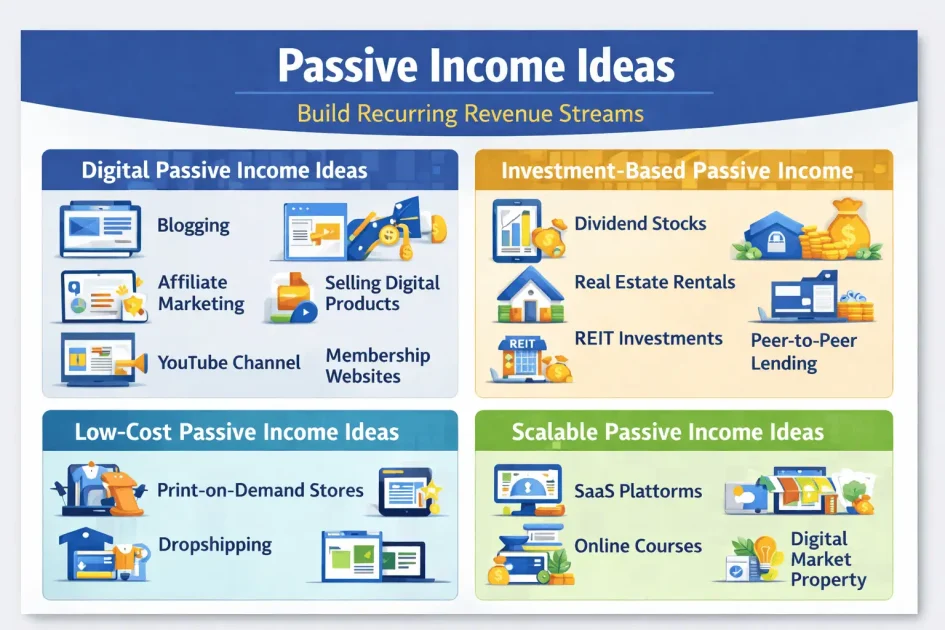
Passive Income Benchmarks: By the Numbers
- Affiliate marketing sites earn $500 to $50,000+ per month at scale; most established sites generate $2,000 to $10,000 per month
- Online courses average $1,500 to $5,000 per month per active course for established creators
- Dividend portfolios yield 3 to 8% annually; a $100,000 portfolio generates $3,000 to $8,000 per year passively
- Rental properties generate $200 to $3,000+ per month in net cash flow per door depending on market and financing
- Print-on-demand sellers with 200 to 500 designs earn $500 to $3,000 per month in royalties
- Most beginners earn $200 to $1,000 per month in passive income within their first 12 months; $2,000 to $5,000 per month is a realistic 24-month target with consistent effort
What Are Passive Income Ideas?
Passive income ideas are specific, actionable income models that generate revenue with significantly reduced ongoing time input once the initial asset, system, or investment has been created or acquired.
Two things are true of every passive income idea in this guide. First, none of them are truly effortless. Each requires a front-loaded investment of time, capital, or both before the passive phase begins. Second, all of them produce income that continues independently of your hours worked once that investment is made. The distinction is not between hard and easy. It is between income that stops when you stop and income that continues after you finish.
How to Evaluate a Passive Income Idea
Before choosing a model, four variables determine whether a specific passive income idea is the right fit for your situation right now.
Startup capital required. Some models, primarily investment-based ones, require money to generate money. Others, including content creation and digital products, can be started with almost nothing. Matching the capital requirement to what you actually have available is the first filter.
Upfront time investment. Every passive income idea has a build phase. The length of that phase varies enormously, from one to three months for a digital template product to twelve to twenty-four months for an affiliate content site. Your financial runway determines which timelines are realistic for you.
Skills required. Some models leverage skills you may already have: writing, design, financial analysis, property management experience, or professional expertise worth packaging. Others require learning something new. The fastest path to passive income almost always runs through existing skills rather than new ones.
Passivity level at scale. Not all passive income ideas are equally passive once established. A rental property managed personally requires ongoing time. A dividend ETF requires almost none. Understanding the ongoing maintenance requirements before committing to a model prevents the common experience of building something that turns out to require more time than expected indefinitely.
Passive Income Ideas: The Complete Breakdown
1. Affiliate Marketing Through Content
Affiliate marketing is one of the most accessible passive income ideas for people who can create content. You publish articles, videos, or newsletters that help people make purchasing decisions, embed affiliate links to the products or services you recommend, and earn a commission when a reader or viewer clicks through and buys. The FTC requires disclosure of affiliate relationships in published content.
The passive mechanism is organic traffic. A well-researched article that ranks on the first page of Google for a high-intent search query generates clicks and commissions every day without additional work. An article written three years ago can earn as much today as it did in its first month, often more as the domain authority of the site increases over time.
The most profitable affiliate niches are those where buyers are making significant purchasing decisions: financial products, software and SaaS tools, business education, health and wellness products, and high-ticket consumer goods. Commission rates vary enormously. Physical product affiliates through Amazon Associates pay 1-10%. Software and SaaS affiliates commonly pay 20-40% recurring monthly commissions, meaning you earn every month the referred customer continues their subscription. High-ticket programs in finance and business education pay $100-$1,000+ per referral.
Building a profitable affiliate content site requires three to twelve months of consistent content production before organic traffic and income become significant. The sites that succeed are those that build genuine topical authority by covering a subject comprehensively. Google consistently rewards depth, expertise, and user satisfaction over volume.
Startup cost: $50-$500 | Time to passive income: 12-24 months | Income range: $500-$50,000+/month for established sites in high-commission niches | Best for: Writers, bloggers, and content strategists willing to invest in a long-term compounding asset.
2. Digital Products: Courses, Ebooks, and Templates
Selling digital products is the closest thing to a pure passive income idea available to people with expertise or creative skills. You create the product once, set up an automated delivery system, and earn revenue every time a new customer purchases, without any additional time investment per sale.
Online courses are the highest-margin category. A well-built course on a topic with genuine market demand, priced at $200-$2,000, can generate $5,000-$30,000/month for a creator with an established audience and a functional marketing system. The upfront investment is significant: most quality courses take 40-100 hours to create, record, and polish. The ongoing maintenance is minimal.
Ebooks and guides represent a lower-price-point but faster-to-create entry into digital products. A well-researched ebook priced at $17-$47 generates meaningful income when distributed through an SEO-driven content site or an established email list.
Templates, presets, Notion systems, spreadsheet tools, and design assets occupy a middle ground that has grown significantly as a passive income category. Professionals who create tools they use in their own work, and then package and sell those tools to others in similar roles, often find product-market fit quickly because they are solving a problem they personally understand.
The distribution strategy is the critical variable. A digital product with no traffic source generates nothing. The most reliable distribution channels for passive digital product income are an SEO-driven blog that attracts buyers organically, an email list built through a lead magnet, and social media content that drives consistent traffic to the product page.
Startup cost: $0-$500 | Time to passive income: 1-6 months after product creation and distribution setup | Income range: $200-$30,000+/month depending on product type, pricing, and audience size | Best for: Experts, educators, and creators who want income that scales beyond hours worked.
3. Dividend Investing
Dividend investing is the most reliably passive income idea available, with one significant requirement: capital. Dividend stocks, index funds with dividend components, and dividend-focused ETFs pay regular income distributions, typically quarterly, based on the number of shares held. The income requires no ongoing active involvement beyond periodic portfolio rebalancing and reinvestment decisions.
The mathematics are straightforward. A portfolio generating an average 4% annual yield pays $4,000/year per $100,000 invested. A $500,000 portfolio at 4% yields $20,000/year, or approximately $1,667/month. Reinvesting dividends during the accumulation phase compounds the growth significantly.
The most reliable dividend income comes from companies with long track records of consistent dividend payments. In the United States, Dividend Aristocrats are S&P 500 companies that have increased their dividends for 25 or more consecutive years. In Canada, the major banks and several pipeline and utility companies have similarly long records. Broad-based dividend ETFs provide instant diversification with a single purchase.
REITs deserve specific mention within this category. Real estate investment trusts are required by the SEC to distribute at least 90% of their taxable income to shareholders as dividends, resulting in yields that typically range from 3-8%. Publicly traded REITs provide exposure to commercial real estate income without the capital requirements or management responsibilities of owning physical property. For Canadian investors, REITs held inside a TFSA or RRSP generate tax-advantaged income that compounds efficiently.
Startup cost: $1,000+ | Time to passive income: Immediate, but meaningful income requires significant capital accumulation | Income range: $4,000-$20,000/year per $100,000-$500,000 invested at 4% yield | Best for: People with capital to deploy who want the most reliable, lowest-maintenance passive income available.
4. YouTube Channel Monetization
A monetized YouTube channel generates passive income through the YouTube Partner Program, which pays creators based on ad revenue generated by their videos. Once a video is published and indexed, it continues generating views and ad revenue indefinitely without additional work.
Income per view varies significantly by niche. Channels in finance, business, technology, and professional development earn $5-$15 per 1,000 views from ad revenue alone. Entertainment and lifestyle channels earn $1-$4 per 1,000 views. A finance channel generating 500,000 monthly views earns $2,500-$7,500/month from ads, before sponsorship deals, affiliate links, or product sales are added.
The passive mechanism deepens over time as the channel accumulates a library of evergreen content. A tutorial video on a perennial topic attracts consistent search-driven views for years. Channels that deliberately build an evergreen library rather than chasing trending topics build a more reliable passive income stream.
Reaching the YouTube Partner Program monetization threshold of 1,000 subscribers and 4,000 watch hours typically takes six to eighteen months for a consistently publishing channel. The first twelve to eighteen months require active production. The passive phase begins when the library is large enough to attract consistent organic traffic without constant new content.
Startup cost: $200-$1,000 | Time to passive income: 12-24 months | Income range: $500-$20,000+/month for established channels | Best for: People comfortable on camera or with audio production who want a long-term compounding content asset.
5. Rental Income from Real Estate
Rental income is the oldest and most well-understood passive income idea. You purchase a property, rent it to tenants, and collect monthly income after mortgage, taxes, insurance, and maintenance costs are covered.
The passive element requires deliberate structuring. Self-managed rental properties require genuine ongoing work. The path to truly passive rental income runs through professional property management: paying a management company 8-12% of monthly rent to handle all operational aspects while you collect the net income.
The key metrics for evaluating rental income potential are the cap rate, the ratio of net operating income to property value, and the cash-on-cash return, the ratio of annual pre-tax cash flow to total cash invested. A property generating a 6-8% cap rate in a stable market with a 20% down payment typically produces a cash-on-cash return of 8-12% before tax benefits.
Short-term rentals through platforms like Airbnb represent a higher-income but more active variant. Properties in high-tourism markets can generate two to three times the income of comparable long-term rentals, though professional short-term rental management companies can systematize much of the operational work.
Startup cost: $20,000+ down payment | Time to passive income: Immediate once tenanted; acquisition takes 3-6 months | Income range: $200-$3,000+/month net cash flow per property | Best for: People with capital for a down payment who want a tangible, appreciating asset generating monthly income.
6. Print-on-Demand Products
Print-on-demand is a genuinely low-barrier passive income idea for people with design skills. Platforms like Redbubble, Merch by Amazon, and Society6 allow you to upload designs that are printed on products only when a customer orders. There is no inventory, no upfront manufacturing cost, and no fulfillment work. You upload the design and collect a royalty on every sale.
The income potential scales with the volume and quality of designs uploaded, niche targeting, and shop optimization. A passive portfolio of 200-500 designs across multiple platforms generates $500-$3,000/month for sellers who have mastered niche research. Top print-on-demand sellers with thousands of designs earn $5,000-$20,000+/month.
The genuinely passive element is the royalty income from designs already uploaded. A design that gains traction generates sales every month without additional work. Building that royalty base requires consistent design production over 6-18 months.
Startup cost: $0-$200 | Time to passive income: 3-6 months for first sales; 12-18 months for reliable income | Income range: $200-$5,000+/month for established sellers | Best for: Designers and creatives who want a genuinely passive royalty income model with no inventory risk.
7. Licensing and Royalties
Licensing income is earned when you own intellectual property, including written works, music, photography, software, or brand assets, and grant others the right to use it in exchange for recurring payments.
Stock photography and video through platforms like Shutterstock, Adobe Stock, and Getty Images pay royalties every time a licensed image is downloaded. A portfolio of 500-2,000 high-quality, commercially relevant images generates $500-$3,000/month in passive royalty income for established contributors.
Music licensing through platforms like Musicbed and Artlist generates royalty income every time a licensed track is used in a video, advertisement, or film. Musicians who build a library of production-quality tracks in high-demand genres can generate $1,000-$10,000+/month from a catalog built over one to three years.
Book royalties from self-published ebooks through Amazon KDP represent a lower-barrier entry into publishing income. A well-researched nonfiction book in a commercial niche, properly optimized for Amazon search, generates $200-$2,000/month in passive royalties. Authors who build a catalog of five to twenty titles in a focused niche generate royalty income that compounds with each addition.
Startup cost: $0-$2,000 | Time to passive income: 6-18 months | Income range: $200-$10,000+/month depending on catalog size and licensing niche | Best for: Musicians, photographers, writers, and creators who want to build a royalty income portfolio from work they are already producing.
8. High-Yield Savings and Fixed Income
High-yield savings accounts, GICs, and bonds represent the lowest-risk passive income option for capital that needs to remain liquid or protected. In the current interest rate environment, high-yield savings accounts pay 4-5% annually in both Canada and the United States. On $50,000 in savings, that generates $2,000-$2,500/year with zero effort and full capital protection.
Peer-to-peer lending platforms offer higher returns in the 5-12% range at higher risk. Income is passive once capital is deployed, though periodic reinvestment is required as loans are repaid.
These options are best understood as a component of a broader passive income portfolio rather than a standalone strategy. They provide stability, liquidity, and a guaranteed return that anchors riskier income-producing assets.
Startup cost: $1,000+ | Time to passive income: Immediate | Income range: $2,000-$6,000/year per $50,000 deployed | Best for: People who want the safest, most liquid form of passive interest income with no market risk.
9. Automated E-Commerce and Dropshipping
A dropshipping business routes customer orders directly to a supplier who fulfills and ships the product, eliminating inventory from the business owner’s responsibilities. When combined with automated marketing systems and email sequences, dropshipping can approach genuine passive income for an established store.
The passive element is not present at launch. Building a profitable store requires product research, supplier vetting, ad campaign creation and optimization, and customer service system development. This active phase typically takes three to six months. Once a store has proven products and automated systems, ongoing management time can be reduced to a few hours per week.
The stores that generate reliable passive-like income are those with differentiated product selection, a strong brand identity, and customer retention systems that reduce dependence on paid advertising for every sale.
Startup cost: $1,000-$5,000 | Time to passive income: 6-12 months to a systematized, low-maintenance operation | Income range: $1,000-$20,000+/month for established stores | Best for: Entrepreneurs willing to invest significant upfront work in building a system that runs with minimal ongoing oversight.
10. Membership Sites and Subscription Communities
A membership site charges subscribers a recurring monthly or annual fee for access to exclusive content, tools, community, or services. Once the platform is built and a subscriber base is established, monthly revenue is predictable and largely passive.
The passive income potential is directly tied to churn rate. A membership with 5% monthly churn loses half its subscriber base in approximately fourteen months without new member acquisition. Memberships with strong community engagement and consistent value delivery sustain lower churn and build more reliable income.
Pricing ranges from $10-$50/month for content-based communities to $100-$500/month for professional communities with high-value tools or expert access. A membership with 500 subscribers at $29/month generates $14,500/month in recurring revenue. At that scale, most value delivery can be systematized through pre-recorded content and automated onboarding.
Startup cost: $200-$1,000 | Time to passive income: 6-18 months to a self-sustaining subscriber base | Income range: $1,000-$50,000+/month for established memberships | Best for: Content creators and educators with an established audience and recurring value to deliver.
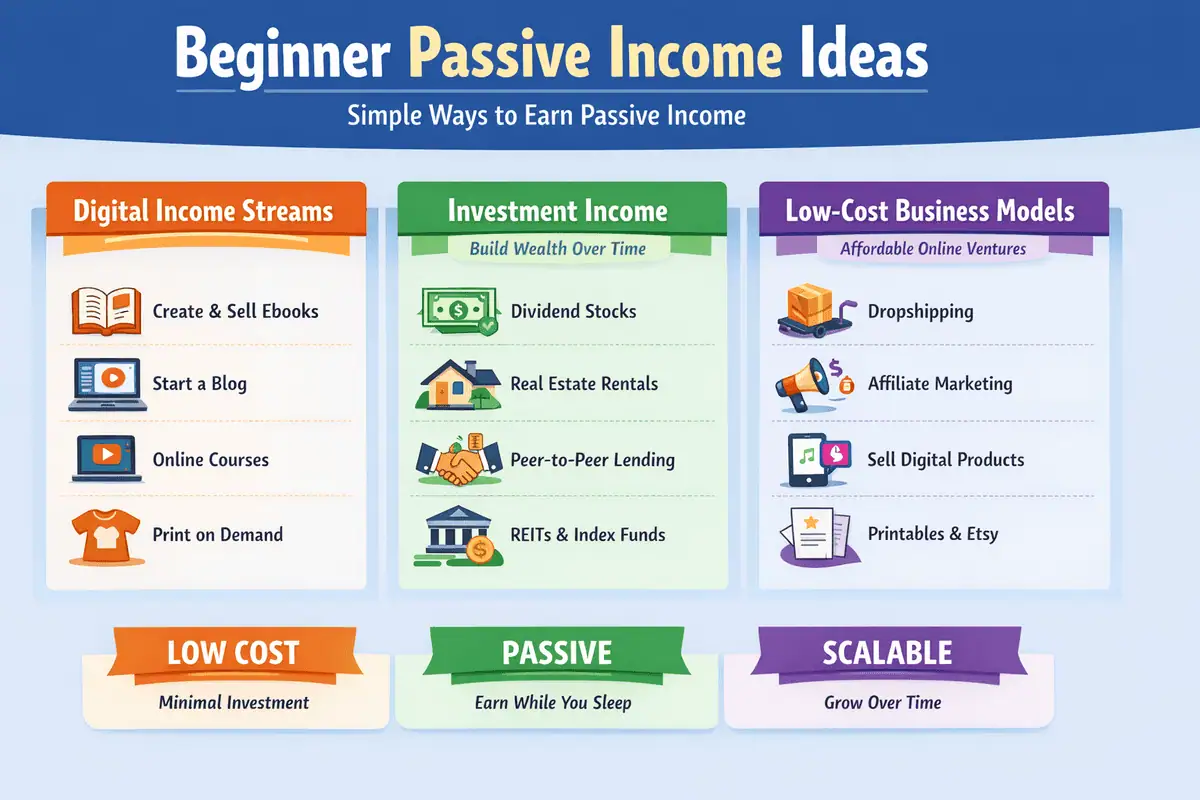
Passive Income Ideas Comparison Table
| Passive Income Idea | Startup Cost | Upfront Work | Time to Passive Income | Monthly Income Potential | Passivity at Scale |
|---|---|---|---|---|---|
| Affiliate Marketing | $50-$500 | High | 12-24 months | $500-$50,000+ | Very High |
| Digital Products (courses) | $100-$500 | Very High | 3-6 months | $500-$30,000+ | Very High |
| Digital Products (templates) | $0-$100 | Medium | 1-3 months | $200-$8,000+ | Very High |
| Dividend Investing | $1,000+ | Low | Immediate | Capital-dependent | Highest |
| YouTube Monetization | $200-$1,000 | Very High | 12-24 months | $500-$20,000+ | High |
| Rental Property | $20,000+ | High | 3-6 months | $200-$3,000+/property | Medium-High |
| Print-on-Demand | $0-$200 | Medium | 6-12 months | $200-$5,000+ | Very High |
| Licensing and Royalties | $0-$2,000 | High | 6-18 months | $200-$10,000+ | Very High |
| High-Yield Savings / GICs | $1,000+ | Very Low | Immediate | Capital-dependent | Highest |
| Automated Dropshipping | $1,000-$5,000 | Very High | 6-12 months | $1,000-$20,000+ | Medium |
| Membership Sites | $200-$1,000 | Very High | 6-18 months | $1,000-$50,000+ | Medium-High |
How to Choose the Right Passive Income Idea
Choosing a passive income idea is a resource allocation decision. You have three resources to invest: time, money, and skills. The right idea is the one that makes the best use of what you have most of right now.
If you have more time than money and strong writing or content skills, affiliate marketing and blogging offer the highest long-term return on time invested. If you have expertise or professional knowledge worth packaging, digital products and online courses offer the best return on existing intellectual capital. If you have capital to deploy and minimal time for content or product creation, dividend investing and REITs offer the most reliable, lowest-maintenance passive income available.
Matching Ideas to Starting Capital
Under $500: Affiliate marketing, digital templates, print-on-demand, YouTube. All require time rather than money and build genuinely passive assets over 12-24 months.
$500-$5,000: Digital courses, automated dropshipping, membership sites. Higher upfront effort but stronger income potential per hour invested at scale.
$5,000-$20,000: Dividend portfolio building, P2P lending, mixed digital and investment approach. Capital starts generating income immediately even as content assets are being built in parallel.
$20,000+: Rental property, real estate investment, larger dividend portfolios. Highest income ceiling with the most capital-efficient path to replacing active income.
Common Mistakes When Choosing a Passive Income Idea
The first mistake is choosing based on income ceiling rather than fit. Every idea in this guide can generate significant income for the right person with the right inputs. The ceiling means nothing without the matching skills, time, and capital to reach it.
The second mistake is underestimating the build phase. Every passive income idea has a period of front-loaded, decidedly non-passive work. Planning for that period, financially and psychologically, is what separates people who push through it from people who conclude that passive income is a myth after abandoning their effort at month four.
The third mistake is trying to build multiple ideas simultaneously before any one of them is generating reliable income. Diversification is a strategy for people who have already built something. Concentration is the strategy for people who are still building. Pick one idea, build it to consistent monthly income, and only then add a second stream.
The fourth mistake is spending early passive income rather than reinvesting it. The compounding effect that makes passive income genuinely life-changing is a function of reinvestment. The first $500/month of affiliate income reinvested into content production, link building, or a parallel digital product compounds into something significantly larger than the same $500 spent on lifestyle improvement each month.
Conclusion
The best passive income idea is not the one with the highest ceiling or the most compelling success story. It is the one that matches your available resources closely enough to actually get built, fits your timeline realistically enough to sustain the effort through the build phase, and has a clear path to the income level you are targeting.
Start with what you have. If you have skills and time but limited capital, start with affiliate content, digital products, or a YouTube channel. If you have capital and limited time, start with dividend investing or REITs. If you have both, build in parallel and let each asset fund the next.
The passive income ideas in this guide are starting points. For the active income foundation that funds the passive phase, start with Side Hustle Ideas and How To Make Money Online.
About the Author
Pierre Charles is the founder of SelfEmployedIdeas.com and host of the Self Employed Ideas podcast. An entrepreneur and self-employment strategist based in Ottawa, Ontario, Canada, Pierre built this platform to help beginners move from traditional employment into independent income — covering business models, passive income systems, freelancing, digital businesses, and financial independence.
Frequently Asked Questions About Passive Income Ideas
Which passive income idea is best for someone with no money to invest?
Affiliate marketing through a content site, digital product creation, print-on-demand, and YouTube monetization all require minimal upfront capital, typically under $200, and can be started with time investment rather than money. Of these, digital templates and print-on-demand tend to produce first income the fastest, typically within one to three months. Affiliate marketing and YouTube take longer but build larger assets over time.
Which passive income idea generates income the fastest?
High-yield savings accounts and dividend investments generate income immediately, but require capital. Among no-capital ideas, digital templates and print-on-demand typically produce first sales within one to three months. Affiliate marketing and YouTube are the slowest starters but the highest earners per hour invested once established.
How do I know which passive income idea matches my skills?
Map your existing professional skills, creative abilities, and knowledge areas against the ideas in this guide. A financial professional with writing skills is well-positioned for affiliate content in the finance niche. A designer with an existing portfolio is well-positioned for print-on-demand and digital template products. A teacher or subject matter expert should look at digital courses first. The fastest path to passive income almost always runs through skills you already have.
Can you build multiple passive income streams at once?
Technically yes, practically it is usually counterproductive until at least one stream is generating consistent monthly income. Building multiple ideas simultaneously before any one is established typically means none of them reach maturity. The more effective sequence is to build one idea to reliable income, then add a second that complements the first without competing for the same time and attention.
Are passive income ideas worth the upfront effort?
Yes, for the right model at the right stage. The return on upfront effort for established affiliate sites, digital course businesses, and dividend portfolios is among the highest available to individuals without institutional capital or significant connections. The people for whom it is not worth it are those who underestimate the build phase and abandon the effort before the compounding begins. The upfront effort is real. The passive income that follows is also real.
What is the difference between a passive income idea and a passive income system?
A passive income idea is a specific vehicle: an affiliate site, a course, a rental property. A passive income system is the architecture that connects multiple ideas, sequences their development, manages capital allocation across them, and compounds their combined output into long-term wealth. This guide covers the ideas. The full system connects them.
How much passive income can a beginner realistically earn?
A realistic expectation for a beginner in the first 12 months is $200 to $1,000 per month in passive income, depending on the model chosen and the consistency of the build phase. Digital templates and print-on-demand can reach $200 to $500 per month within 3 to 6 months for someone who produces consistent work. Affiliate marketing and blogging typically generates $100 to $500 per month at the 12-month mark, growing to $1,000 to $5,000 per month by months 18 to 24 for sites with strong content and SEO. Dividend investing generates passive income immediately but requires capital; $10,000 invested at a 5% yield produces approximately $500 per year or $42 per month. Online courses take the most upfront effort but offer the highest beginner ceiling: a course priced at $300 to $500 with a small existing audience can generate $1,000 to $3,000 per month within 6 months of launch. The honest benchmark is this: with consistent effort and a realistic 12 to 24 month timeline, most beginners who stick with a single model build $500 to $2,000 per month in passive income. Significant passive income, $5,000 per month and above, typically reflects 2 to 3 years of compounding effort in a single model or a combination of streams built sequentially.