Financial independence is the goal of generating enough income from businesses, investments, and assets to cover living expenses without relying on traditional employment.
Many individuals pursue financial independence through a combination of entrepreneurship, scalable income systems that generate earnings beyond traditional employment, and long-term wealth-building strategies. Instead of depending on a single salary, financially independent individuals build multiple income streams that provide stability and flexibility.
Understanding how financial independence works requires examining the underlying systems that generate income. Business ownership, passive income assets, investment portfolios, and scalable income models all contribute to achieving long-term financial freedom.
This guide explains the core principles behind financial independence and how different income strategies work together to create sustainable wealth.
What Is Financial Independence?
Financial independence refers to the ability to support your lifestyle through income generated from assets, investments, or businesses rather than relying solely on traditional employment.
Individuals who reach financial independence typically build income from multiple sources such as:
• business ownership
• investment income
• passive income assets
• real estate investments
• digital income streams
The key objective is to create income systems that generate revenue consistently over time.
When income generated from these sources exceeds personal expenses, individuals gain the flexibility to work on their own terms or pursue entrepreneurial projects.
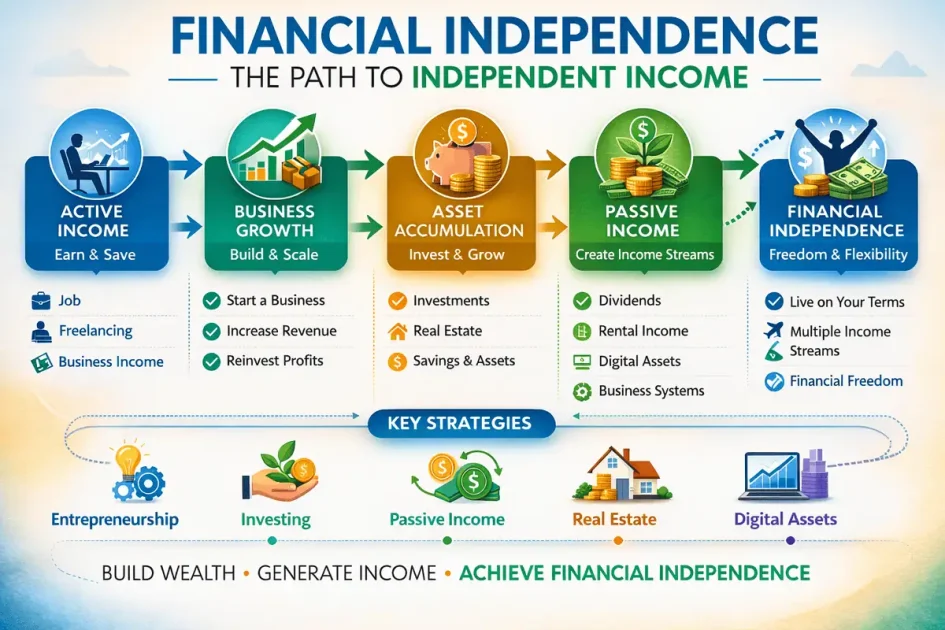
The Financial Independence Framework
Achieving financial independence generally follows a structured progression.
| Stage | Focus |
| Income Creation | Building active income through work or business |
| Income Expansion | Increasing income through entrepreneurship or career growth |
| Asset Accumulation | Investing income into assets that generate returns |
| Passive Income Development | Building recurring income streams |
| Financial Independence | Income from assets exceeds living expenses |
Each stage builds upon the previous one, gradually shifting income from active labor toward asset-based income.
Active Income vs Passive Income
Financial independence typically requires moving from active income toward passive income.
Active Income
Active income is generated through direct labor or services.
Examples include:
• employment income
• consulting services
• freelance work and independent service-based income models.
• service businesses
Active income is essential in the early stages because it provides the capital needed to build investments.
Passive Income
Passive income is generated by assets that produce income with limited ongoing effort.
Examples include:
• dividend-paying stocks
• rental properties
• digital products
• affiliate marketing income
• automated online businesses
Passive income allows individuals to build income streams that continue producing revenue over time.
Core Strategies for Financial Independence
Several strategies contribute to achieving financial independence.
Building Scalable Businesses
Entrepreneurship is one of the fastest ways to increase income.
Business models that scale well include:
• digital businesses and online income models built for scalability.
• consulting services
• marketing agencies
• e-commerce stores
Scalable businesses allow entrepreneurs to increase revenue without proportionally increasing labor.
Developing Passive Income Streams
Passive income streams gradually reduce dependence on active work.
Examples include:
• blogging businesses
• digital product sales
• subscription services
• affiliate marketing
These systems generate recurring income as audiences or customer bases grow.
Investing in Dividend-Producing Assets
Dividend investing allows investors to receive regular income through portfolio-based income strategies that generate consistent returns from companies distributing profits to shareholders.
Dividend stocks can provide:
• consistent income
• portfolio diversification
• long-term wealth growth
Dividend income often becomes a core component of financial independence strategies.
Real Estate Income
Real estate investing can generate income through property-based wealth strategies that produce both cash flow and long-term asset growth through rental properties or property appreciation.
Common strategies include:
• rental property investing
• real estate investment trusts (REITs)
• property development
Real estate assets often produce both cash flow and long-term asset growth.
How Long Does It Take to Achieve Financial Independence?
The timeline varies depending on several factors:
• income level
• savings rate
• investment strategy
• business success
Some individuals achieve financial independence in 10–15 years through aggressive investing and entrepreneurship, while others may take longer depending on their financial goals and lifestyle.
The key factor is consistently building income-generating assets over time.
Financial Independence vs Financial Freedom
Although often used interchangeably, the two concepts can differ slightly.
| Concept | Meaning |
| Financial Independence | Income from assets covers essential living expenses |
| Financial Freedom | Wealth allows complete lifestyle flexibility |
Financial independence typically represents the foundation, while financial freedom represents the ultimate goal.
Financial Independence Income Systems
Financial independence is usually achieved through a combination of income systems rather than a single strategy. These systems generate income from different sources, reducing financial risk and creating long-term stability.
Most financially independent individuals build multiple income streams that work together.
Below are some of the most common income systems used to achieve financial independence.
Business Income Systems
Entrepreneurship can generate significant income through structured business models designed for long-term scalability that accelerates the path toward financial independence.
Examples include:
• digital businesses
• consulting services
• marketing agencies
• e-commerce businesses
• online education platforms
These businesses often generate the capital needed to build investment portfolios and passive income assets.
Digital Passive Income Systems
Digital income systems allow entrepreneurs to generate income online using traffic-driven growth strategies and scalable content systems with scalable business models.
Examples include:
• blogging income
• affiliate marketing
• digital product sales
• membership websites
• online courses
These systems can eventually produce recurring income as audiences and traffic grow.
Investment Income Systems
Investment portfolios are a common long-term strategy for financial independence.
Investment income sources include:
• dividend-paying stocks
• index funds
• bonds
• real estate investment trusts
These investments produce income while also allowing capital to grow over time.
Real Estate Income Systems
Real estate remains one of the most established wealth-building strategies.
Income sources include:
• rental properties
• commercial real estate
• property syndications
• real estate investment funds
Real estate assets often provide both cash flow and long-term appreciation.
comparison table
| Income System | Scalability | Risk Level | Time Required |
| Business Ownership | High | Medium | High |
| Dividend Investing | Medium | Low | Low |
| Real Estate | Medium | Medium | Medium |
| Digital Products | High | Medium | Medium |
Conclusion
Financial independence is achieved by building income systems that generate revenue beyond traditional employment. By combining entrepreneurship, passive income strategies, investments, and structured income frameworks that support long-term financial growth, individuals can gradually reduce reliance on active work.
The process requires long-term planning, consistent income generation, and disciplined investment strategies. Over time, multiple income streams can create a stable financial foundation that supports independence and flexibility.
Frequently Asked Questions About Financial Independence
What is financial independence?
Financial independence is the point at which income generated from assets, investments, or businesses is sufficient to cover living expenses without relying on traditional employment.
How do people achieve financial independence?
Most people achieve financial independence by combining active income, business ownership, investments, and passive income strategies such as dividend investing, real estate, or digital assets.
How much money is needed for financial independence?
The amount required depends on lifestyle expenses and investment returns. Many financial planners use a guideline where individuals accumulate enough assets to generate income that covers their annual expenses.
Can entrepreneurs reach financial independence faster?
Entrepreneurs may reach financial independence faster if they build scalable businesses that generate high income and allow reinvestment into income-producing assets.