The office is no longer a requirement for a career. What started as a pandemic-era necessity has become a permanent structural shift in how work gets done. For millions of people, working from home is no longer a perk. It is the baseline expectation.
The numbers reflect it. Remote and hybrid roles now account for a significant share of all professional job postings across North America, and demand continues to outpace the number of qualified candidates in several high-income categories. That gap represents real opportunity for anyone willing to develop the right skills and position themselves correctly.
But the phrase “work from home jobs” covers an enormous range of realities. On one end sits legitimate, well-paying remote employment with benefits, career progression, and six-figure earning potential. On the other end sit low-paying gig tasks, data entry mills, and outright scams dressed up as opportunity. Navigating between them requires a clear framework, which is exactly what this guide provides.
Whether you are looking to leave a traditional office role, transition out of employment entirely, or build a home-based income from scratch, this guide maps the full landscape: every major category, what each one pays, what it requires, and how to get started with maximum efficiency. Many of these roles are the first step into beginner self employment opportunities that offer flexibility, control, and long-term income potential.
Work From Home by the Numbers
22 million Americans work from home full-time (BLS, 2024)
Remote workers save an average of $6,000/year in commuting and work expenses
Entry-level remote roles start at $12–$20/hour; skilled roles reach $50–$200/hour
Demand for remote-friendly roles grew 135% between 2020 and 2024
Freelance remote workers earn a median of $28/hour across all categories
Work From Home Income Ranges: By the Numbers
- Software developers earn $60,000 to $250,000+ per year remotely — the highest-paying work from home category
- Freelance copywriters and content strategists earn $75 to $200 per hour at the senior level
- Remote bookkeepers and accountants earn $20 to $150 per hour depending on credential level
- Digital marketing specialists earn $45,000 to $120,000+ per year; freelance retained clients pay $3,000 to $15,000 per month
- Remote consulting and advisory work earns $75 to $300+ per hour — the highest hourly rate available from home
- Entry-level remote work (customer service, VA, tutoring) pays $15 to $35 per hour with no experience required
What Is a Work From Home Job?
A work from home job is any form of paid employment or self-employed income that is performed primarily or entirely from a home location, using digital tools and internet connectivity to deliver work, communicate with employers or clients, and receive compensation.
The category spans two fundamentally different structures that are often conflated. The first is remote employment: a traditional job with a salary, benefits, and an employer, performed remotely instead of in an office. The second is home-based self-employment: independent work where you control your clients, rates, and schedule, and operate as a business rather than an employee.
Both are legitimate. Both can be lucrative. But they have different income ceilings, different tax implications, different risk profiles, and different paths to getting started. Understanding which structure you are entering, and which one you actually want, is the first decision worth getting right. Frameworks like the income classification system help clarify how remote employment, self-employment, and asset-based income each produce income differently.
The Work From Home Landscape: What Has Actually Changed
The shift to remote work is not temporary or cosmetic. It is structural, and the data shows it clearly. Before 2020, remote work was largely confined to tech, marketing, and a handful of niche professional services. Today it spans accounting, law, healthcare administration, project management, sales, engineering, customer experience, and dozens of other fields that were traditionally office-bound.
Three forces are sustaining this shift. First, employers have discovered that productivity does not require physical presence, and that remote hiring dramatically expands their talent pool beyond local geography. Second, workers who have experienced remote work are highly reluctant to return to full office environments, making remote flexibility a major retention and recruitment factor. Third, the infrastructure supporting remote work, including video conferencing, project management platforms, cloud-based collaboration tools, and secure VPNs, has matured to the point where working from home is operationally indistinguishable from working in an office for most roles.
For job seekers, this means the barrier to finding legitimate, well-compensated remote work has never been lower. The competition is higher than it was in 2020 and 2021, but the volume of available roles has grown in proportion. The candidates who position themselves correctly, with demonstrated remote work skills, a professional home setup, and clear expertise in a high-demand field, consistently find opportunities at every experience level.
Framework: How Work From Home Jobs Become Scalable Income
The infographic below illustrates how work from home jobs can evolve from simple remote roles into scalable income systems and long-term business opportunities.
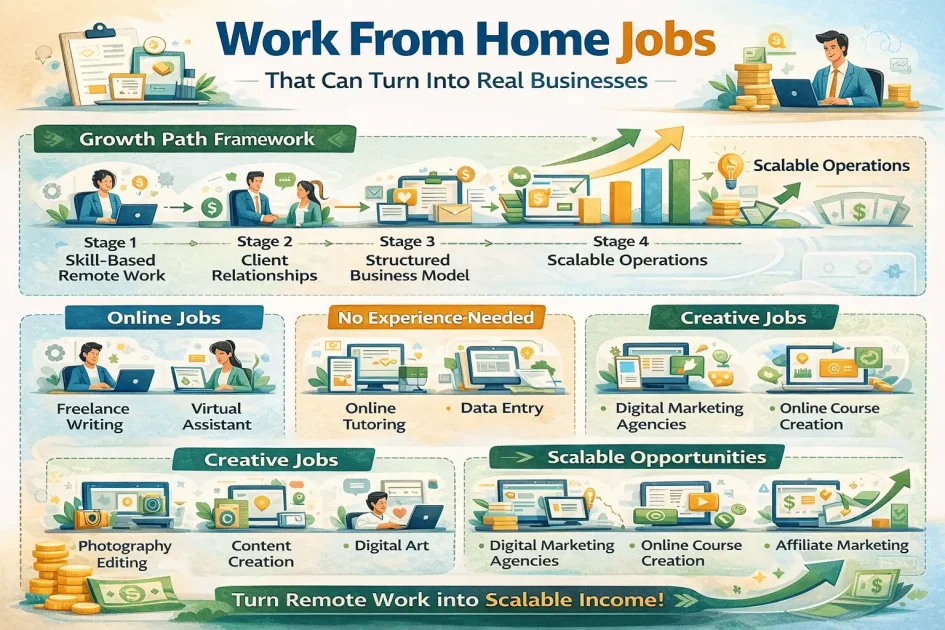
This progression highlights why many remote workers transition from freelance or entry-level roles into structured businesses and multiple income streams. Many begin exploring passive income opportunities to reduce reliance on time-for-money work, and evolve toward the structured models covered in types of income models in self employment, where income becomes more predictable and systems replace manual effort.
Work From Home Jobs: The Complete Category Breakdown
Technology and Software Development
Technology remains the most remote-friendly sector by a significant margin. Software developers, web developers, DevOps engineers, data scientists, cybersecurity analysts, and UX designers have been working remotely for years, long before it became a widespread trend. The skills are transferable across industries, the compensation is high, and the demand shows no signs of plateauing.
Entry-level developers can expect $60,000 to $85,000 per year in most North American markets. Mid-level engineers with three to five years of experience typically earn $90,000 to $130,000. Senior and specialized roles, particularly in machine learning, cloud infrastructure, and security, regularly command $150,000 to $250,000 or more.
The path into tech from a non-technical background has shortened considerably. Bootcamps, online degree programs, and self-directed learning through platforms like freeCodeCamp, The Odin Project, and Coursera produce job-ready developers in 12 to 18 months. The caveat is that the entry-level market is more competitive than it was three years ago, and differentiation through a strong portfolio of real projects matters more than credentials alone.
Remote tech roles are among the most geographically flexible work from home jobs. A developer in Ottawa earning a salary benchmarked to Toronto or San Francisco rates can significantly outpace local cost of living, making remote tech work one of the highest-leverage financial decisions available to someone willing to invest in the skills.
Best roles for remote work: Frontend developer, backend developer, full-stack developer, data analyst, UX/UI designer, cybersecurity analyst, cloud engineer, QA engineer.
Remote workers in this role commonly earn: web developers $50–$200/hour as freelancers; entry-level developers on the lower end of that range, senior full-stack or specialized engineers at the upper end. Salaried remote roles typically pay $85,000–$180,000/year for mid-to-senior experience levels in North American markets.
Writing, Content, and Copywriting
Professional writing is one of the most accessible paths to remote income because the barrier to entry is relatively low, the demand is enormous, and the ceiling for skilled practitioners is genuinely high. Every company with a digital presence needs content: blog posts, landing pages, email sequences, case studies, whitepapers, social media copy, product descriptions, and more.
Generalist content writers typically earn $25 to $60 per hour or $0.05 to $0.15 per word at the commodity end of the market. Specialized copywriters, particularly those who write for conversion, financial services, SaaS, or health and wellness, regularly earn $75 to $200 per hour. Direct response copywriters with a proven track record command fees that make most other remote income categories look modest by comparison.
The fastest way to move up the rate ladder in writing is specialization. A generalist blogger earns $50 per article. A B2B SaaS content strategist charges $500 to $2,000 per piece. The work is not ten times harder. The positioning is ten times sharper.
The investment in building a strong writing portfolio early pays compounding dividends. Writers who publish consistently under their own name, whether through a personal blog, LinkedIn articles, or contributed pieces to industry publications, build a body of work that attracts inbound client inquiries rather than requiring constant outreach to find the next project.
Best roles for remote work: Content writer, SEO writer, copywriter, technical writer, grant writer, ghostwriter, email marketer, content strategist.
Remote workers in this role commonly earn: freelance writers $30–$150/hour depending on specialization and experience; proofreaders and editors $25–$60/hour. Entry-level rates are at the lower end of each range; specialists in SaaS, finance, or technical fields reach the upper end within 12–24 months.
Digital Marketing and SEO
Digital marketing encompasses a broad range of disciplines, including paid advertising, search engine optimization, social media management, email marketing, analytics, and conversion rate optimization, all of which can be performed entirely remotely. The demand for skilled digital marketers continues to grow as businesses shift more of their budgets from traditional to digital channels.
Entry-level digital marketing roles typically pay $45,000 to $65,000 per year. Specialists with demonstrable expertise in high-value areas like paid search, programmatic advertising, or SEO command $70,000 to $120,000 or more. Freelance digital marketers who work directly with clients often earn significantly more, between $3,000 and $15,000 per month for retained client relationships in competitive niches.
The most valuable differentiator in digital marketing is data literacy. Marketers who can read analytics, build attribution models, and connect their work to measurable revenue outcomes command a significant premium over those who can only execute tactics. Developing proficiency in Google Analytics, Google Ads, Meta Ads Manager, and at least one SEO platform like Ahrefs or Semrush positions a digital marketer in the top tier of the remote candidate pool. These roles tie directly into scalable marketing systems, where traffic, audience, and monetization are structured for long-term growth.
Best roles for remote work: SEO specialist, paid search manager, social media manager, email marketing specialist, content marketing manager, marketing analyst, growth marketer.
Remote workers in this role commonly earn: social media managers $28–$88/hour depending on scope and platform expertise; paid search specialists and marketing analysts tend toward the middle of the range. Freelance retained clients pay more per hour than salaried roles at comparable experience levels.
Customer Service and Support
Remote customer service has expanded dramatically as companies have shifted their support operations away from physical call centers. The roles range from entry-level chat support to technical support specialists and customer success managers, and the compensation varies accordingly.
Entry-level customer service roles typically pay $15 to $22 per hour, accessible without a degree and often with minimal prior experience. Customer success managers with account management responsibilities at SaaS companies earn $60,000 to $100,000 or more, often with performance bonuses tied to renewal rates and expansion revenue.
Customer service is one of the most reliable entry points for people with no remote work experience. It requires strong written communication, patience, problem-solving skills, and a quiet home workspace, but not specialized technical knowledge. It also frequently leads to promotions into quality assurance, training, and operations roles for people who demonstrate initiative and competence beyond the baseline requirements.
The most strategic use of an entry-level customer service role is as a bridge to higher-value work. Someone who joins a SaaS company in a support role and develops product knowledge, customer empathy, and process documentation skills is well-positioned to transition into customer success, product operations, or marketing within 12 to 18 months, often without leaving the same employer.
Best roles for remote work: Customer support specialist, technical support agent, customer success manager, live chat agent, customer experience analyst.
Typical rates range: customer service representatives $15–$25/hour at the entry level; technical support and customer success roles reach $25–$40/hour as responsibilities expand. Data entry roles in this category typically earn $12–$20/hour and are among the lowest-barrier remote options for new workers.
Finance, Accounting, and Bookkeeping
Financial roles have proven highly compatible with remote work. Bookkeeping, accounting, financial analysis, tax preparation, and financial planning can all be performed with secure cloud-based tools and encrypted communication platforms. The work is deadline-driven rather than presence-driven, which makes the home environment a natural fit.
Remote bookkeepers typically earn $20 to $40 per hour. Accountants with CPA credentials earn $65,000 to $110,000 per year in salaried roles, or $75 to $150 per hour as independent contractors. Financial analysts at mid-to-senior levels earn $80,000 to $140,000 or more. Tax preparers working seasonally can earn $30,000 to $60,000 over a four-month window.
The accounting and finance space is particularly well-suited to home-based self-employment. A freelance bookkeeper serving 8 to 10 small business clients at $400 to $800 per month each builds a $50,000 to $80,000 per year business with predictable, recurring income and a largely self-directed schedule. The shift to cloud-based accounting platforms like QuickBooks Online, Xero, and FreshBooks has made remote bookkeeping operationally seamless for both the bookkeeper and the client.
Best roles for remote work: Bookkeeper, staff accountant, CPA, financial analyst, tax preparer, payroll specialist, fractional CFO.
Typical rates range for remote bookkeepers: $20–$50/hour for general bookkeeping, with specialized or full-charge bookkeepers reaching the higher end. Remote workers in this role commonly earn $30–$50/hour once they have established a consistent client base of 5–10 small businesses.
Project Management and Operations
Project managers and operations professionals are increasingly valued in remote-first companies precisely because distributed teams require more deliberate coordination than co-located ones. The ability to manage timelines, communicate clearly across time zones, and keep projects on track without physical oversight is a premium skill in the remote economy.
Entry-level project coordinators earn $50,000 to $70,000. Certified project managers with three to seven years of experience earn $85,000 to $130,000. Senior operations leads and directors of remote teams at scaling companies regularly earn $120,000 to $180,000 or more.
Certifications like PMP, CAPM, or Agile/Scrum credentials significantly improve competitiveness for remote project management roles. These credentials signal not just technical knowledge but the professional discipline that remote employers specifically look for in candidates they cannot supervise in person.
Best roles for remote work: Project manager, program manager, operations manager, scrum master, business analyst, product manager.
Education, Tutoring, and Instructional Design
Online education has expanded significantly in scale, and the demand for remote educators spans K to 12 tutoring, corporate training, university instruction, language teaching, and instructional design. The income varies enormously by format and credential level.
Online tutors on platforms like Wyzant or Varsity Tutors earn $25 to $80 per hour depending on subject and level. ESL teachers working with international students earn $15 to $30 per hour. Corporate trainers and instructional designers developing e-learning content earn $60,000 to $110,000 per year. The instructional design field in particular is growing rapidly as organizations shift more of their training programs to self-paced digital formats, creating sustained demand for people who can design learning experiences rather than just deliver them.
Best roles for remote work: Online tutor, ESL teacher, instructional designer, e-learning developer, curriculum writer, corporate trainer.
Remote workers in online tutoring commonly earn: general K–12 tutoring $20–$50/hour; test prep and subject specialists $40–$80/hour; ESL instruction $15–$30/hour. Transcriptionists (often categorized under educational support) typical rates range $15–$30/hour, with medical and legal specialists at the upper end.
Virtual Assistance and Administrative Support
Virtual assistants provide administrative, organizational, and operational support to businesses, entrepreneurs, and executives entirely online. The scope of VA work ranges from basic inbox management and calendar scheduling to specialized support in areas like social media management, bookkeeping, podcast production, or customer relations.
General VAs typically earn $18 to $35 per hour. Specialized VAs with skills in areas like paid advertising management, CRM administration, or executive support at the C-suite level earn $40 to $75 per hour. The role is one of the most accessible paths to remote income for people with strong organizational skills and professional communication ability, and it frequently evolves into an operations or business management role as the relationship with the client deepens. Virtual assistance is also a common first step for parents building flexible income, often leading into stay-at-home mom business ideas where flexibility and scalability become priorities.
Best roles for remote work: General virtual assistant, executive assistant, social media VA, real estate VA, podcast VA, project management VA.
Remote workers in this role commonly earn: general virtual assistants $15–$35/hour; specialized VAs with skills in project management, CRM administration, or executive support $35–$50/hour. Typical rates range higher for VAs serving high-growth startups or C-suite executives where responsiveness and confidentiality are priorities.
Healthcare and Telehealth
Healthcare is a less frequently discussed but rapidly growing category for remote work. Telehealth platforms have normalized remote consultations, and the administrative and technical infrastructure supporting healthcare has shifted substantially online. Roles range from medical billing and coding to telemedicine nursing, mental health counseling, and healthcare IT.
Medical coders and billers typically earn $18 to $35 per hour remotely, with specialty coders earning more. Telehealth nurses and nurse practitioners in remote consultation roles earn $70,000 to $120,000 or more. Remote mental health counselors and therapists who see clients via video earn comparable rates to in-person practice in most states and provinces, with the added benefit of eliminating office overhead.
Best roles for remote work: Medical coder, medical biller, telehealth nurse, remote therapist or counselor, health informatics specialist, healthcare data analyst.
The infographic below highlights the most popular work from home jobs across different categories, helping you quickly identify the best path based on your experience level and income goals.
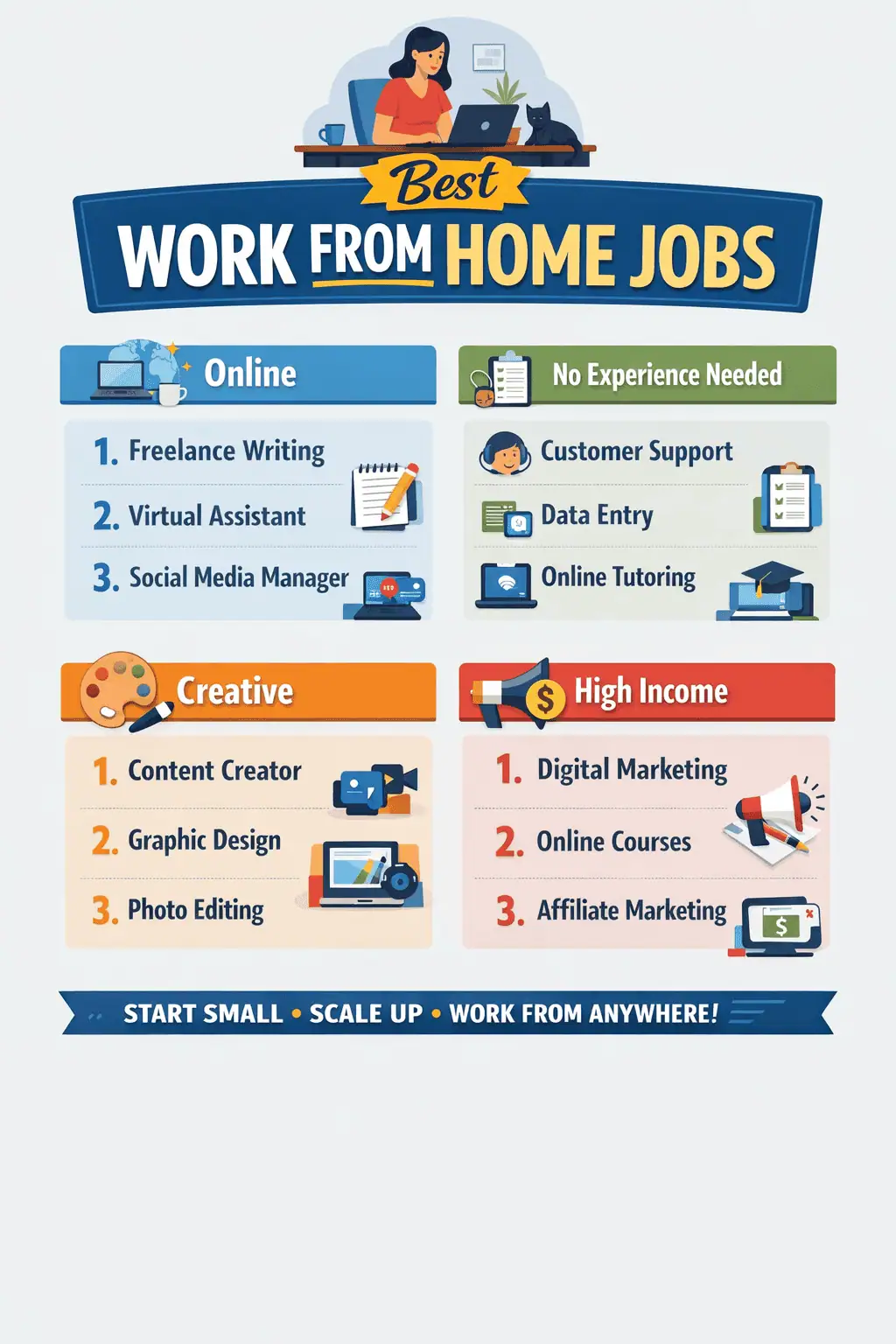
These categories show that remote work opportunities are not limited to entry-level roles. Many can evolve into scalable income streams or full online businesses.
Work From Home Jobs: Category Comparison
The table below compares the major work-from-home categories across the dimensions that matter most when making a decision: income range, time to first income, skill barrier, and whether the role is better suited to employment or self-employment.
| Category | Avg. Income Range | Time to First Income | Skill Barrier | Best As |
|---|---|---|---|---|
| Software Development | $60K to $250K+/yr | 12 to 24 months (if learning) | High | Employment or freelance |
| Copywriting / Content Writing | $25 to $200/hr | 2 to 8 weeks | Low to Medium | Freelance or employment |
| Digital Marketing / SEO | $45K to $120K+/yr | 4 to 12 weeks | Medium | Employment or agency |
| Customer Service / Support | $15 to $40/hr | 1 to 3 weeks | Low | Employment |
| Bookkeeping / Accounting | $20 to $150/hr | 2 to 6 weeks | Medium to High | Freelance or employment |
| Project Management | $50K to $180K+/yr | Varies by credential | Medium to High | Employment |
| Online Teaching / Tutoring | $15 to $80/hr | 1 to 4 weeks | Low to Medium | Platform or freelance |
| Virtual Assistance | $18 to $75/hr | 1 to 3 weeks | Low | Freelance |
| UX / UI Design | $65K to $140K+/yr | 6 to 18 months (if learning) | High | Employment or freelance |
| Data Analysis | $60K to $130K+/yr | 6 to 12 months (if learning) | High | Employment |
| Consulting / Advisory | $75 to $300+/hr | 4 to 16 weeks | High (expertise req.) | Self-employed |
| Technical Writing | $35 to $90/hr | 2 to 6 weeks | Medium | Freelance or employment |
| Healthcare / Telehealth | $18 to $120K+/yr | 2 to 8 weeks | Medium to High | Employment |
How to Choose the Right Work From Home Job for Your Situation
The comparison table gives you the landscape. Choosing your entry point requires mapping that landscape against four personal variables: your existing skills, your income timeline, your risk tolerance, and your long-term goal.
If you need income within two to four weeks, focus on the low-barrier, fast-start categories: customer service, virtual assistance, content writing, or online tutoring. These roles have the shortest onboarding timelines and the most available entry-level positions. The income ceiling at the entry level is lower, but they generate immediate cash flow while you develop higher-value skills in parallel.
If you have two to six months before you need the income, the medium-barrier roles open up. Bookkeeping, digital marketing, and copywriting can all be learned to a job-ready level in this window. Bookkeeping in particular is underrated. A certified bookkeeper with a small client base earns more per hour than most entry-level tech roles, with significantly less learning investment.
If you are playing a 12 to 24 month game and have either existing technical skills or the capacity to develop them, software development, UX design, and data analysis offer the highest long-term income ceilings in the remote job market. These fields require genuine expertise, but that expertise commands compensation that puts a well-built career ahead of almost every other remote option.
The self-employment versus employment question deserves serious attention. Employment offers stability, benefits, and a defined career path. Self-employment offers higher hourly rates, schedule control, and income that is not capped by a salary band. Most people who thrive in home-based self-employment started with employment. They learned the industry, built a client network, and then transitioned to independent practice with existing relationships and a demonstrated track record. Understanding core business structure becomes essential as you move beyond freelancing or entry-level work.
If you’re just starting out, the infographic below highlights beginner-friendly work from home jobs that require little to no experience and can be started immediately.
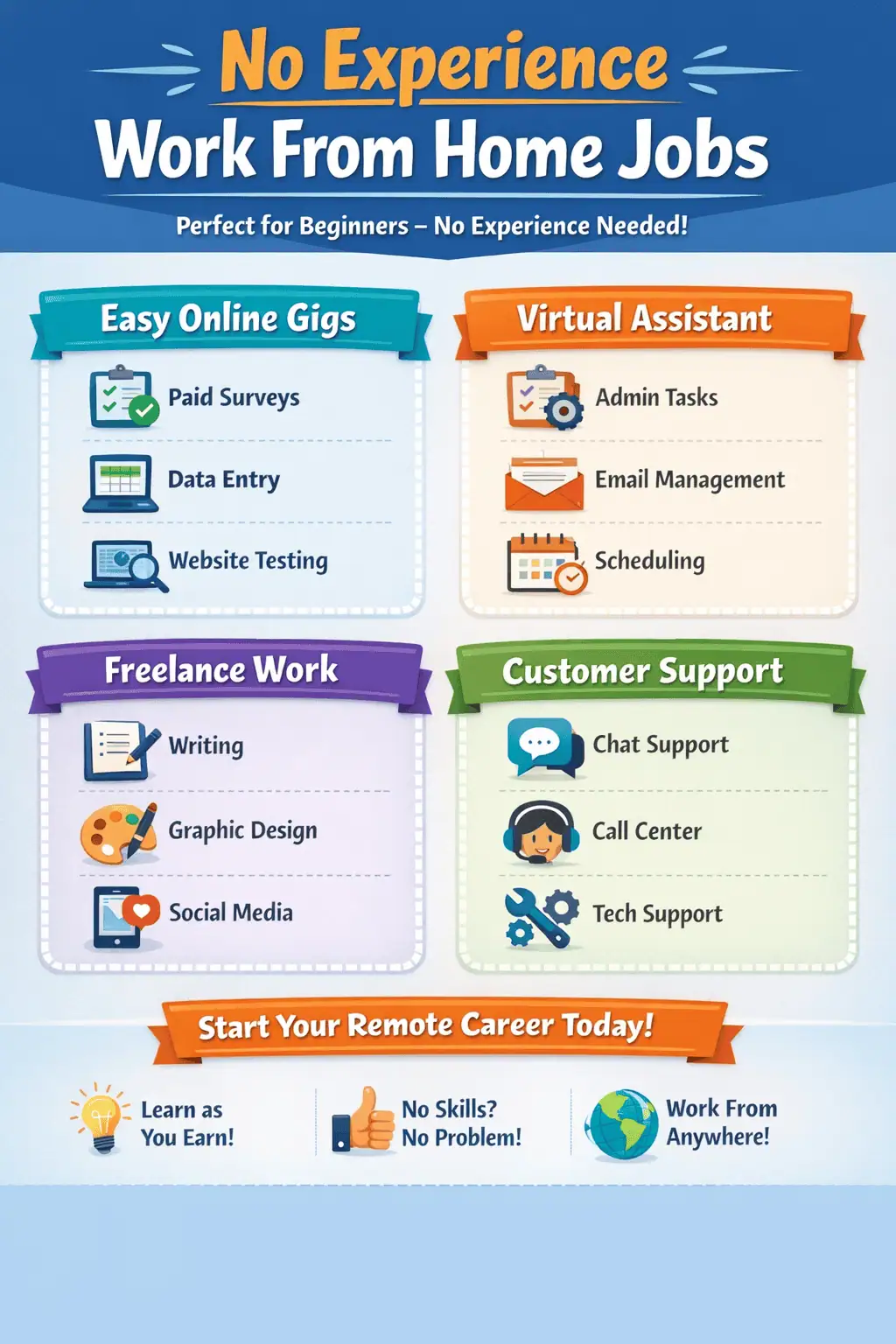
These entry-level opportunities are often the first step before transitioning into higher-paying remote roles or building scalable online income streams.
How to Find Legitimate Work From Home Jobs
The market for remote work is large enough to support strong job boards, reputable platforms, and direct application pipelines, but it is also large enough to attract scammers. The line between a legitimate remote opportunity and a financial trap is not always obvious.
Legitimate remote job sources include platform-specific boards like Remote.co, We Work Remotely, FlexJobs, and LinkedIn’s remote job filter. Company career pages are particularly valuable. Many organizations post remote roles directly without going through aggregators, and competition is lower for candidates who find them there. Professional networks, particularly LinkedIn, remain the highest-conversion channel for mid-to-senior remote roles.
Optimizing Your Application for Remote Roles
Remote employers screen candidates differently from traditional employers. They are not evaluating whether you will be a pleasant presence in the office. They are evaluating whether you can manage your own time, communicate proactively without being prompted, deliver quality work without supervision, and operate effectively with minimal synchronous interaction.
The most important thing you can do to improve your success rate with remote applications is demonstrate these qualities explicitly rather than assuming they are implied. Your resume and cover letter should include specific examples of independent work, self-managed projects, and outcomes delivered without direct oversight. If you have any prior remote work experience, make it prominent. If you do not, describe the closest equivalents: freelance projects, independent study, volunteer work, or any context where you drove a result autonomously.
On the freelance side, Upwork remains the largest and most reliable platform for finding client work in writing, development, design, marketing, and virtual assistance. Toptal serves the top end of the technical market. Fiverr works well for productized services. Direct outreach to small and mid-size businesses via cold email, LinkedIn, or referral consistently produces better-paying client relationships than platforms, with zero platform fees.
The warning signs for scams are consistent: any opportunity that asks for upfront payment to access work, promises unusually high pay for simple tasks, requires you to purchase equipment or training from a specific vendor, or asks for banking or identity information before confirming employment. Legitimate employers and clients do not require you to spend money to earn money.
Setting Up for Success: What a Productive Home Work Environment Requires
The quality of your home work environment directly affects your performance, your professional credibility on video calls, and your long-term sustainability in remote work. This is not about luxury. It is about removing the friction that costs you concentration, client confidence, and career opportunities.
The baseline requirements are straightforward: a dedicated workspace that is physically separate from living areas where possible, a reliable high-speed internet connection with a wired backup option, a quality webcam and external microphone for professional video communication, and a comfortable ergonomic setup that supports extended focused work without physical strain.
Beyond the basics, the tools that most consistently improve remote work productivity are project management software for tracking work and deadlines, time-blocking systems that protect deep work from synchronous communication interruptions, and clear boundaries with household members about work hours and interruption norms.
The professionals who struggle most with remote work are almost universally those who have not created the physical and temporal separation that an office environment provides automatically. The ones who thrive have rebuilt that structure deliberately, on their own terms, in their own space.
The Three-Tier Home Setup Framework
Most remote workers progress through three distinct setup tiers as their income and professional needs grow. The baseline tier handles the majority of remote roles without issue: a laptop, a headset, a stable internet connection, and a dedicated desk space separate from sleeping and living areas. This setup covers customer service, virtual assistance, writing, tutoring, and most entry-level professional roles.
The professional tier adds an external monitor, a quality webcam, a standalone microphone, an ergonomic chair, and a wired internet connection. This is the setup that creates a genuinely professional video call presence and supports extended focused work sessions. Most mid-to-senior remote professionals operate at this level.
The optimized tier adds a standing desk, broadcast-quality audio and video, dual monitors, acoustic treatment for the workspace, and a backup power solution. This level is appropriate for consultants and coaches whose video presence is a direct reflection of their professional brand, content creators who record regularly, and senior professionals whose home office is effectively their primary client-facing environment.
Work From Home vs. In-Office: What the Research Actually Shows
The debate over remote versus in-office work generates more opinion than evidence in most public discussions. The actual research tells a more nuanced story than either side typically acknowledges.
Productivity in remote roles is generally equal to or higher than in-office productivity for individual contributors doing focused, asynchronous work: writing, coding, analysis, and design. It is measurably lower for roles that depend on spontaneous collaboration, rapid ideation, or the kind of informal relationship-building that happens naturally in shared physical space.
Career advancement is the legitimate concern for remote workers. Studies have consistently shown that remote employees are less likely to be promoted than in-office counterparts at companies with strong physical office cultures. This gap narrows significantly in fully remote organizations and in companies that have deliberately restructured their promotion and visibility systems for distributed teams. The practical implication is that remote workers at hybrid or office-first companies should be deliberate about visibility: proactive communication, visible contributions in shared channels, and regular touchpoints with decision-makers who would otherwise forget they exist.
The financial calculus is clear and quantifiable. Eliminating a daily commute saves the average North American worker $5,000 to $15,000 per year in transportation, clothing, and food costs, plus 200 to 500 hours of time. That time and money represent real compensation that does not appear in a salary figure but materially changes the value of a remote role relative to an equivalent in-office position.
Building a Long-Term Remote Career Strategy
The remote workers who build the most durable, high-value careers are those who treat remote work as a strategic choice rather than a default. They choose remote-first organizations where distributed work is the norm rather than a concession. They invest in skills and credentials that command premium compensation regardless of location. They build professional networks deliberately through online communities, industry events, and proactive relationship maintenance, rather than assuming that proximity to colleagues will do that work for them.
The transition from remote employment to home-based self-employment, when planned carefully, produces some of the highest-earning outcomes in any category of work from home income. A software developer who goes remote with a large tech company, spends three years developing deep expertise in a specific technical domain, builds a professional reputation through GitHub contributions and technical writing, and then transitions to independent consulting can realistically double or triple their effective hourly earnings while maintaining the same work-from-home lifestyle. For a deeper breakdown of how remote work evolves into scalable income, explore our complete guide to building income beyond active work.
The same pattern applies in digital marketing, finance, project management, and virtually every professional field with strong remote demand. The home office is not the final destination for most high-earners who work from home. It is the platform from which they build something larger.
Conclusion
Work from home jobs are no longer a niche segment of the labor market. They are a mainstream career choice across dozens of industries, income levels, and professional disciplines. The question is not whether legitimate remote work exists. The question is which category fits your skills, your timeline, and your long-term income goals.
Start with an honest assessment of where you are now. If you need income fast, low-barrier roles like virtual assistance, customer service, or content writing give you the fastest path to cash flow. If you are building toward a high-income career, invest in the skills in development, data, and UX that command the highest remote compensation. If you want the freedom and income ceiling of self-employment, explore digital-first business models that pair naturally with any remote professional skill set.
The home office is not a compromise. For the people who approach it with the same intentionality they would bring to any career move, it is an upgrade in flexibility, in financial efficiency, and in the quality of the working life they are able to build.
Frequently Asked Questions About Work From Home Jobs
What are the most legitimate work from home jobs?
The most legitimate work from home jobs are those offered by established companies through verifiable career pages or reputable job boards, or independent freelance work found through established platforms like Upwork, Toptal, or direct client relationships. High-legitimacy categories include software development, digital marketing, content writing, bookkeeping, customer success, project management, and virtual assistance. Any opportunity requiring upfront payment, promising unusually high pay for simple tasks, or requesting banking details before confirming employment should be treated as a scam.
How much can you realistically earn working from home?
Income varies enormously by category and skill level. Entry-level remote roles in customer service and virtual assistance pay $15 to $30 per hour. Mid-level professionals in marketing, writing, and finance earn $50,000 to $90,000 per year. Senior technical roles, specialized consultants, and experienced freelancers regularly earn $100,000 to $250,000 or more. The key variable is not the remote format. It is the market value of the underlying skill being delivered.
Do work from home jobs require experience?
It depends on the category. Customer service, virtual assistance, data entry, and online tutoring frequently hire with no prior remote experience. Strong communication skills and reliability matter more than a resume in those roles. Technical roles like software development and data analysis require demonstrable skill, whether from formal education, bootcamps, or a portfolio of independent projects. Writing and digital marketing fall in between. A strong portfolio of work samples often matters more than a degree.
What equipment do you need to work from home?
At minimum: a reliable computer, high-speed internet with a backup option, a quality webcam and headset or microphone for video calls, and a dedicated workspace. Most remote employers provide or reimburse software licenses. Freelancers working in design, video, or audio may need additional specialized equipment. The baseline investment for a professional remote work setup is $500 to $2,000 if you are starting from scratch.
Is working from home better for your career?
For individual contribution and specialized skill development, remote work is neutral to positive. You have more focused time and fewer interruptions. For career advancement in organizations with strong office cultures, remote workers face real visibility disadvantages. The best career outcomes in remote work come from fully remote companies, from organizations with explicit remote-first policies, or from self-employment where advancement is entirely determined by skill development and client relationships rather than office politics.
How do I avoid work from home job scams?
Apply only through verifiable company career pages, established job boards, or reputable freelance platforms. Never pay to access a job or client list. Be skeptical of roles that promise high pay for minimal skill or effort. Verify the company exists independently before providing any personal information. Legitimate employers will never ask you to purchase equipment from a specific third-party vendor as a condition of employment.
Can work from home jobs lead to full-time self-employment?
Yes, and this is a well-documented transition path. Many people start with remote employment to learn an industry and build a client network, then transition to freelancing or consulting once they have the experience and relationships to sustain independent work. The transition works best when planned: building a client pipeline before leaving employment, pricing services correctly from the start, and treating the freelance practice as a business from day one.
What is the difference between a remote job and working for yourself from home?
A remote job means you are an employee working for an employer who allows or requires you to work from a home location. You receive a salary or hourly wage, typically with benefits, and your income depends on maintaining that employment relationship. Working for yourself from home means you are self-employed: you find your own clients, set your own rates, manage your own taxes, and bear the financial risk and reward of your own business. Remote employment is more stable. Self-employment has a higher ceiling and more autonomy.
What work from home jobs pay the most?
The highest-paying work from home jobs, ranked by earning potential: (1) Software development and engineering at $90,000 to $250,000+ per year for mid-to-senior remote roles; (2) Freelance consulting and advisory work at $75 to $300+ per hour, with top consultants in specialized niches earning $150,000 to $500,000+ per year; (3) Data science and machine learning at $110,000 to $200,000+ per year; (4) UX/UI design at $85,000 to $160,000 per year for experienced practitioners; (5) Copywriting and content strategy at $75 to $200 per hour for senior specialists in high-value niches like finance, SaaS, and health; (6) Digital marketing management at $80,000 to $150,000+ per year for senior roles or retained freelance clients; (7) Remote accounting and fractional CFO services at $75 to $200 per hour. The common thread across the highest-paying remote jobs is specialization: the more precisely defined and difficult to replace your skill, the more the market pays for it, whether you are employed or self-employed.
What work from home jobs pay the most for someone starting out?
The highest-paying remote roles are typically in technology and skilled services. Freelance web developers earn $50–$200/hour, with most mid-level developers working independently in the $75–$120/hour range. Remote bookkeepers and accountants commonly earn $30–$70/hour once established. Social media managers and copywriters typically earn $30–$100/hour depending on experience and client type. Entry-level roles like virtual assistance and data entry pay $12–$25/hour and are accessible without prior remote experience — making them a practical starting point before moving into higher-paying categories.