Passive income is often misunderstood as earning money without effort. In reality, it is the result of deliberate system design, capital allocation, and long-term discipline. True passive income is created by building or acquiring assets that continue to generate returns with decreasing operational involvement over time.
Wealth, in turn, is the outcome of structured accumulation. It is built by reinvesting income, controlling risk, and allowing capital to compound across different asset classes.
This guide explains how passive income systems function, how they scale, and how they connect to broader wealth-building strategies. Rather than focusing on isolated income ideas, it breaks down the structural layers required to move from income generation to financial independence and long-term capital preservation.
These systems apply across a wide range of self employed ideas, depending on your skills and capital
Many individuals begin this journey through independent income structures, then transition into asset-based income systems that reduce reliance on active work.
What Is Passive Income & Wealth?
Passive income is the process of generating revenue through assets and systems that do not require proportional ongoing effort. These income streams are built through digital assets, financial investments, real estate holdings, and recurring revenue structures.
Wealth is not defined by income alone.
Wealth is defined by ownership — specifically, the control of income-producing assets that compound over time and reduce dependence on active labor.
Most individuals focus on earning income.
Few focus on designing financial architecture.
This silo is built around structured systems that transform income into long-term wealth.
Passive income is not just about earning money — it is built through structured systems. The framework below shows how income evolves into assets, automated cash flow, and long-term wealth.

How Passive Income Systems Work
Passive income operates as a structured system — not a single income source. It follows a sequence that transforms active earnings into long-term wealth through asset creation, recurring income, and compounding.
The framework below illustrates how passive income evolves from earned income into automated cash flow and financial independence.
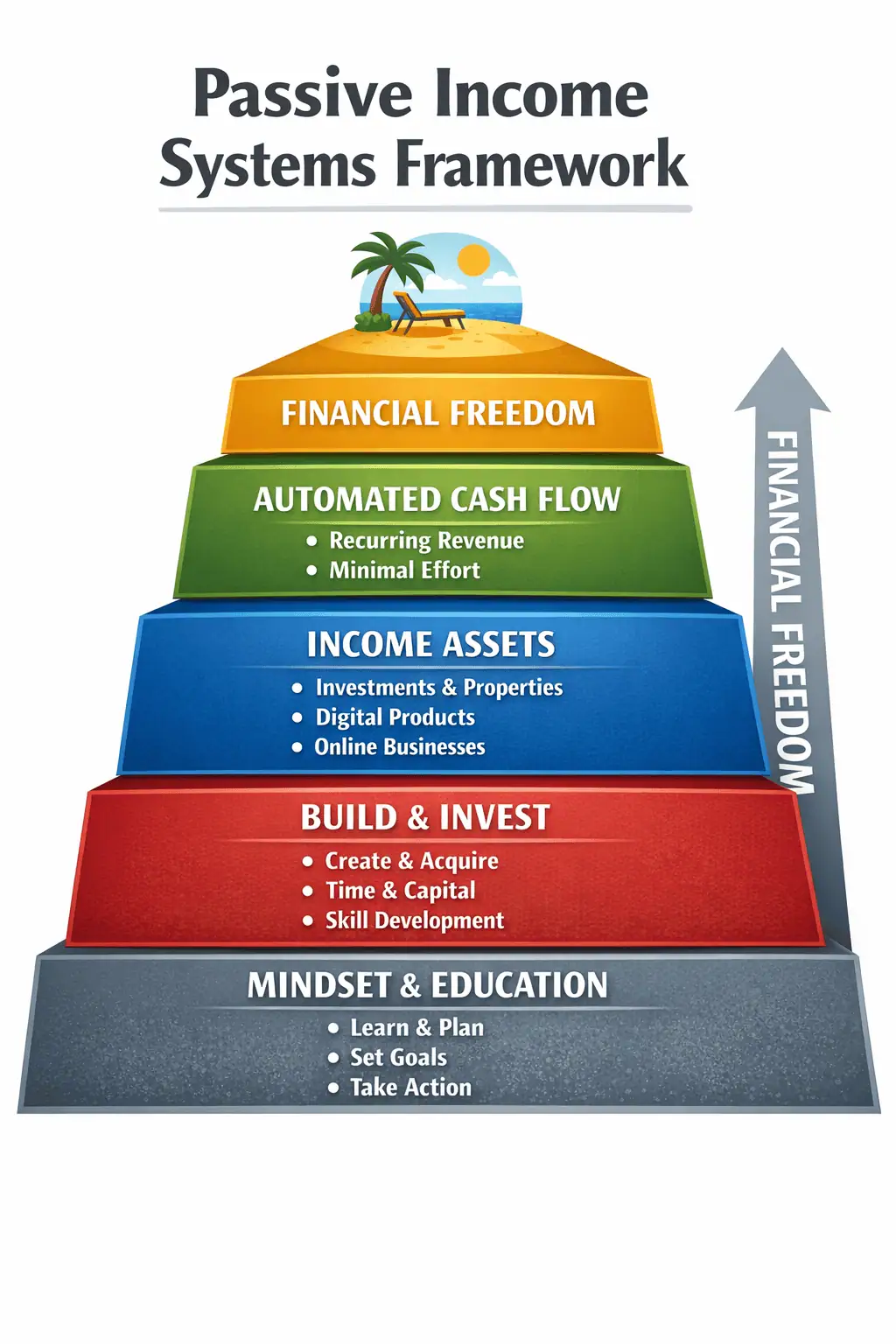
This framework connects directly to how passive income systems operate in real-world scenarios.
At a structural level, these systems follow five stages:
1. Income Generation
Active income is created through business, employment, or independent work.
2. Capital Allocation
Surplus income is directed into investments, assets, or scalable systems.
3. Asset Creation or Acquisition
Capital is used to build or acquire income-producing assets.
4. Income Stabilization
Recurring revenue or investment yield begins to replace active income.
5. Wealth Compounding
Returns are reinvested to expand asset base and increase financial independence.
Passive income is not immediate.
It is built through structured sequencing.
Passive income systems connect closely with structural business systems, particularly in financial management, capital allocation, and risk control.
Core Passive Income & Wealth Systems

1. Digital Passive Income Systems
System Role
Digital systems generate income through automated platforms such as content monetization, software, and digital products.
Revenue Mechanics
Once created, digital assets can be distributed repeatedly with minimal additional cost.
Case Study: Practical Scenario
A content platform grows slowly, then produces recurring income through affiliate systems and digital products.
Case Study: Scaling Scenario
A SaaS platform builds recurring subscriptions that scale without proportional labor.
Common Breakdown Points
Abandoning systems before maturity or underestimating upfront effort.
Strategic Refinement
- focus on niche demand
- build automation
- prioritize recurring revenue
Growth Impact
Digital systems offer the highest scalability potential among passive income structures.
Digital passive income systems rely heavily on structured marketing and growth systems to generate consistent traffic and revenue.
2. Investment-Based Passive Income Systems
System Role
Capital is deployed into financial assets that generate returns through ownership.
Revenue Mechanics
Income is generated through dividends, interest, and appreciation.
Case Study: Practical Scenario
A dividend portfolio gradually replaces a portion of living expenses.
Case Study: Scaling Scenario
A diversified investment portfolio compounds into long-term financial stability.
Common Breakdown Points
Chasing high yield without understanding risk.
Strategic Refinement
- diversify assets
- maintain long-term horizon
- reinvest consistently
Growth Impact
Investment systems provide stability and long-term compounding.
3. Real Estate Income Architecture
System Role
Real estate generates income through cash flow, appreciation, and leverage.
Revenue Mechanics
Rental income, financing structure, and market conditions drive returns.
Case Study: Practical Scenario
A rental property produces stable income while equity grows over time.
Case Study: Scaling Scenario
A portfolio of properties generates diversified income streams.
Common Breakdown Points
Overleveraging or underestimating operational costs.
Strategic Refinement
- conservative financing
- reserve planning
- market selection
Growth Impact
Real estate transforms capital into tangible, scalable wealth systems.
4. Asset-Based Income Design
System Role
Income is generated through ownership of assets rather than labor.
Revenue Mechanics
Assets such as intellectual property, equity, or platforms produce ongoing returns.
Case Study: Practical Scenario
A digital course generates ongoing revenue after creation.
Case Study: Scaling Scenario
Equity ownership produces long-term capital appreciation.
Common Breakdown Points
Failing to convert income into assets.
Strategic Refinement
- prioritize ownership
- reinvest earnings
- diversify asset types
Growth Impact
Asset ownership creates long-term independence and resilience.
Real estate investing is one of the most effective ways to convert capital into long-term income-producing assets.
5. Recurring Revenue Systems
System Role
Recurring systems generate predictable income through subscriptions or repeat payments.
Revenue Mechanics
Retention drives long-term revenue stability and compounding.
Case Study: Practical Scenario
A business transitions from one-time sales to subscription revenue.
Case Study: Scaling Scenario
A membership platform builds predictable monthly income.
Common Breakdown Points
Weak retention leading to high churn.
Strategic Refinement
- improve customer value
- track retention
- optimize lifecycle
Growth Impact
Recurring systems convert volatile income into predictable cash flow.
6. Hybrid Income Models
System Role
Hybrid systems combine active, digital, and asset-based income streams.
Revenue Mechanics
Multiple income layers reduce dependency on a single source.
Case Study: Practical Scenario
A service business adds digital products.
Case Study: Scaling Scenario
Real estate income funds scalable digital systems.
Common Breakdown Points
Building too many streams without stabilizing one.
Strategic Refinement
- sequence growth
- stabilize primary income
- diversify strategically
Growth Impact
Hybrid systems increase flexibility and reduce risk.
These systems often integrate with broader passive income strategies designed to scale income beyond active work.
7. Capital Allocation & Reinvestment Discipline
System Role
Capital allocation determines how income is deployed to build wealth.
Revenue Mechanics
Returns depend on reinvestment rate and allocation efficiency.
Case Study: Practical Scenario
Income is consumed rather than invested, limiting growth.
Case Study: Scaling Scenario
Structured allocation accelerates wealth accumulation.
Common Breakdown Points
Emotional or unstructured reinvestment decisions.
Strategic Refinement
- define allocation strategy
- track performance
- balance risk
Growth Impact
Capital discipline drives long-term compounding.
8. Wealth Preservation & Risk Management
System Role
Protection systems safeguard accumulated assets from risk and loss.
Revenue Mechanics
Reduced downside risk improves long-term stability.
Case Study: Practical Scenario
Unprotected assets become exposed to legal or financial risk.
Case Study: Scaling Scenario
Structured protection preserves wealth across market cycles.
Common Breakdown Points
Ignoring protection until risk materializes.
Strategic Refinement
- diversify exposure
- structure ownership
- maintain insurance
Growth Impact
Preservation ensures wealth durability.
9. Financial Independence Architecture
System Role
Align income-producing assets with personal expense requirements.
Revenue Mechanics
Recurring income replaces reliance on active labor.
Case Study: Practical Scenario
High income without asset backing creates dependency.
Case Study: Scaling Scenario
Layered income exceeds expenses and creates autonomy.
Common Breakdown Points
Lifestyle inflation delaying independence.
Strategic Refinement
- control expenses
- diversify income
- maintain buffers
Growth Impact
Financial independence creates decision freedom.
10. Long-Term Wealth Expansion Strategy
System Role
Expand wealth beyond independence into long-term compounding.
Revenue Mechanics
Reinvestment and growth assets increase total portfolio value.
Case Study: Practical Scenario
Over-conservative strategy slows growth.
Case Study: Scaling Scenario
Balanced approach maintains growth and stability.
Common Breakdown Points
Over-speculation or stagnation.
Strategic Refinement
- rebalance portfolio
- maintain growth exposure
- plan long-term
Growth Impact
Expansion transforms wealth into legacy.
Final Wealth Perspective
Passive income is not a shortcut.
Wealth is not accidental.
Income creation is only the first layer.
True wealth emerges when income is transformed into assets, assets are managed strategically, and capital is allowed to compound over time.
Systems create income.
Discipline creates wealth.
Structure creates long-term financial independence.
Frequently Asked Questions About Passive Income & Wealth
What is passive income?
Passive income is revenue generated from assets or systems that continue producing income with limited ongoing effort.
Is passive income truly passive?
Passive income requires upfront effort or capital and ongoing oversight, but not continuous labor.
What are the safest passive income sources?
Diversified investments, real estate, and stable recurring revenue systems tend to offer lower risk.
How much passive income is needed for financial independence?
It depends on personal expenses, but income must consistently exceed living costs.
Can passive income create long-term wealth?
Yes. When income is reinvested and diversified, passive systems can compound into significant long-term wealth.