Consulting and advisory self employment models represent one of the highest-margin and most intellectually leveraged forms of self employment. Unlike general service delivery, consulting monetizes judgment, expertise, strategic insight, and decision-making capacity rather than execution alone.
Consultants are not hired to “do the work.”
They are hired to improve decisions.
This distinction transforms pricing power, client dynamics, scalability pathways, and enterprise value.
However, many professionals misunderstand consulting architecture. Without clear positioning, structured offers, and authority signaling, advisory businesses collapse into disguised freelance labor.
Understanding the structural mechanics of consulting models determines whether a practice remains time-based income or evolves into a high-value strategic firm.
What Is Consulting Self Employment?
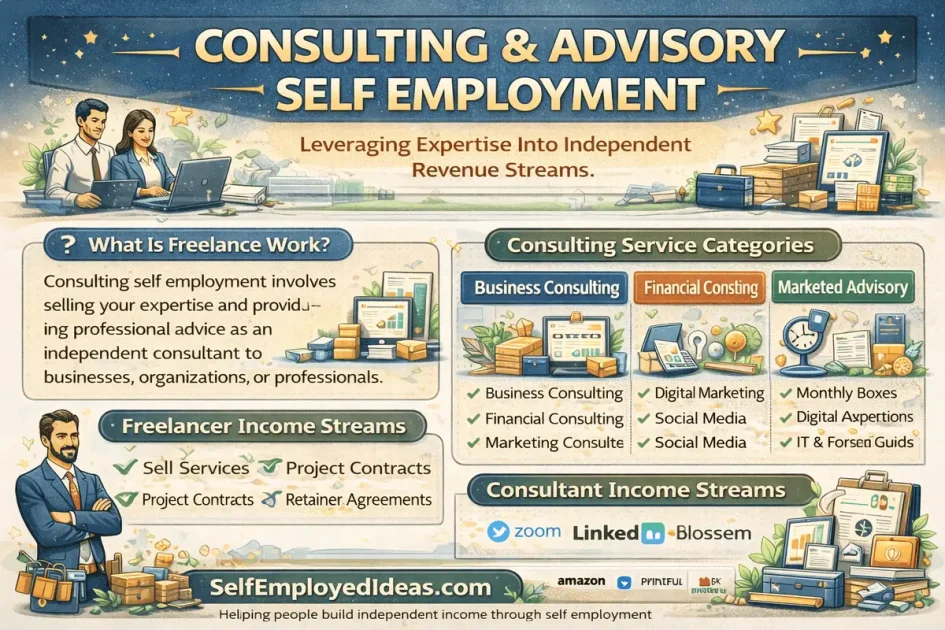
Consulting self employment is a business model where professionals generate income by providing strategic advice, industry expertise, and decision-making guidance to clients. Revenue is typically earned through retainers, advisory contracts, or performance-based agreements rather than task execution.
Foundational Architecture of Advisory Models
Consulting businesses are built around intellectual capital.
Core components include:
• Specialized expertise
• Problem-solving authority
• Decision-impact influence
• Strategic guidance
• Industry positioning
Unlike execution-based services, consulting centers on strategic leverage.
The consultant provides:
Clarity → Strategy → Direction → Oversight
Revenue depends on perceived value, not deliverable volume.
The higher the impact of the advice, the higher the pricing ceiling.
Revenue Mechanics & Value Capture Structure
Consulting income is typically structured through:
• Hourly advisory
• Project-based engagements
• Retainer contracts
• Executive advisory roles
• Equity participation agreements
The economic equation shifts from:
Time × Rate = Income
to
Impact × Perceived Value = Pricing Power
Consultants who tie compensation to outcomes rather than hours significantly increase margin potential.
High-level advisory firms often maintain:
70–85% gross margins
Minimal overhead
High lifetime client value
However, pricing discipline determines sustainability.
Applied Enterprise Scenarios
Scenario 1: Fractional Executive Model
An experienced CFO launches a fractional advisory practice.
Instead of full-time employment, they:
• Serve 3–5 companies
• Offer strategic oversight
• Attend executive meetings
• Guide capital allocation decisions
Revenue remains high.
Workload remains controlled.
Impact remains strategic.
This model commands premium retainers.
Scenario 2: Industry-Specific Strategic Consultant
A supply chain expert specializes exclusively in mid-market manufacturers.
They offer:
• Operational audits
• Cost optimization plans
• Vendor restructuring guidance
Rather than hourly billing, they package:
• Fixed-scope advisory programs
• 6-month transformation retainers
Positioning increases pricing power.
Niche clarity increases authority.
Risk Exposure & Structural Fragility
Consulting models contain subtle risks.
Primary vulnerabilities:
• Founder dependency
• Reputation fragility
• Revenue concentration
• Over-customization
• Authority dilution
Because consulting relies on intellectual authority, brand damage has amplified consequences.
Another common risk is disguised freelancing.
If advisory firms:
• Execute tasks rather than guide decisions
• Compete on hourly rates
• Fail to differentiate strategically
They lose premium positioning.
The line between consultant and contractor must remain clear.
Strategic Refinement & Authority Elevation
Consulting enterprises strengthen through:
1. Niche Dominance
General advisors compete broadly.
Specialists command premiums.
Authority increases when:
• Target market narrows
• Language becomes industry-specific
• Results become measurable
2. Thought Leadership Infrastructure
Authority must be visible.
Consultants should develop:
• Long-form educational content
• Speaking engagements
• Case studies
• Strategic white papers
Perceived expertise increases pricing flexibility.
3. Retainer-Based Stability
Predictable advisory retainers increase enterprise value.
Retainers reduce:
• Client acquisition pressure
• Revenue volatility
• Negotiation friction
Recurring advisory relationships create durability.
4. Equity Participation Models
Advanced consultants may structure:
• Revenue share agreements
• Performance-based bonuses
• Advisory equity stakes
This increases upside but requires risk tolerance.
Comparative Economics: Consulting vs General Services
| Factor | Consulting Model | General Service Model |
| Pricing Basis | Strategic value | Task execution |
| Gross Margin | Very high | High but labor-dependent |
| Client Volume | Low | Moderate to High |
| Authority Requirement | Critical | Moderate |
| Scalability | Limited without brand | Scales with team |
| Valuation Potential | High (if systematized) | Moderate |
Consulting trades volume for margin.
Execution services trade margin for scale.
Hybrid layering can combine both.
Enterprise Expansion & Positioning Strategy
Consulting businesses evolve through:
Stage 1: Independent Advisor
Stage 2: Specialized Authority
Stage 3: Boutique Consulting Firm
Stage 4: Advisory + Digital Asset Hybrid
Stage 5: Thought Leadership Enterprise
The transition from Stage 2 to Stage 3 marks enterprise shift.
This requires:
• Brand building
• Process documentation
• Structured engagement models
• Support staff integration
Authority becomes institutional rather than personal.
Valuation & Exit Dynamics
Consulting firms are valued based on:
• Recurring advisory contracts
• Intellectual property assets
• Brand authority
• Client diversification
• System documentation
Small independent consultants may command:
1.5x–3x annual profit
Structured boutique firms with recurring contracts:
3x–6x annual profit
Firms with strong brand equity and intellectual property:
Higher multiples depending on defensibility.
The more revenue is tied to systems rather than personality, the higher the valuation.
Expanded Conclusion
Consulting and advisory self employment sits at the premium tier of independent income models. It monetizes strategic influence rather than execution, allowing for high-margin operations with relatively low client volume.
However, authority positioning, niche clarity, and structured engagement models determine success.
Without differentiation, consulting collapses into freelance labor.
With strategic architecture, consulting evolves into institutional advisory enterprise.
Impact determines income.
Authority determines leverage.
Structure determines longevity.
Consulting is not about doing more work.
It is about improving higher-level decisions.
Frequently Asked Questions
What is the difference between consulting and freelance services?
Consulting focuses on strategic guidance and high-level decision support, while freelance services primarily deliver execution-based tasks. Consultants influence direction; freelancers complete deliverables.
Is consulting scalable?
Consulting can scale through niche positioning, retainer contracts, delegation to associate consultants, and layering digital assets such as courses or intellectual property.
How do consultants increase pricing power?
Pricing power increases through specialization, thought leadership, proven case studies, and positioning as an authority within a narrowly defined market segment.
Can consulting businesses be sold?
Yes. Advisory firms with recurring contracts, documented processes, diversified client bases, and reduced founder dependency often command strong valuation multiples.
What is the biggest risk in consulting models?
The primary risk is overreliance on personal reputation and time. Without systematization and recurring contracts, revenue remains vulnerable and non-transferable.